Wayne Lumbasi

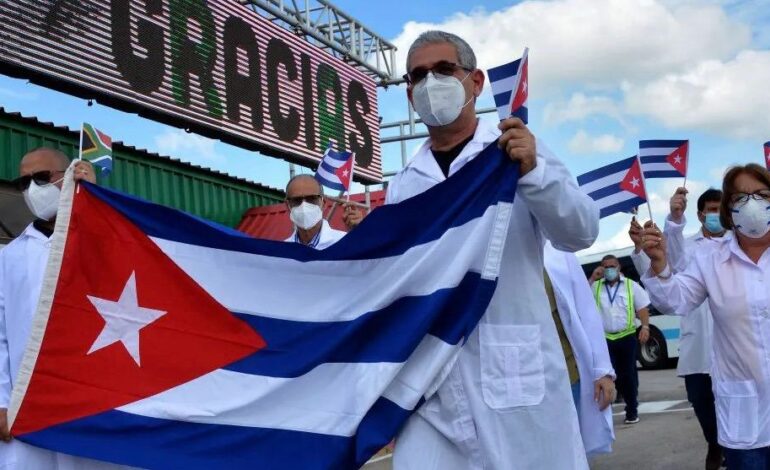
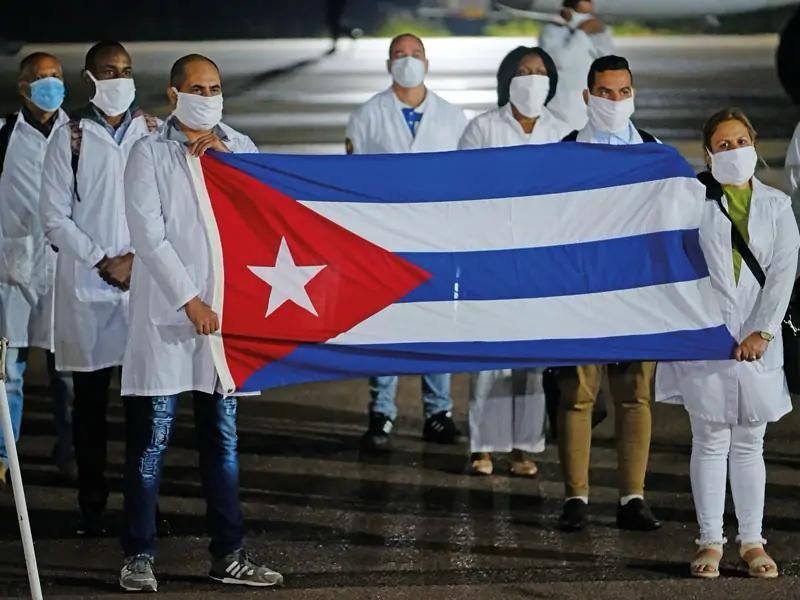
For half a century, the sight of Cuban lab coats in rural clinics and public hospitals was a constant across the Caribbean. From the interior of Guyana to the mountains of Jamaica, these “medical brigades” formed the backbone of regional healthcare systems that struggled with the persistent “brain drain” of locally trained staff to the West. However, as of April 2026, this decades-old alliance is unraveling.
Under intense diplomatic and economic pressure from the United States, several Caribbean and Latin American nations have begun a rapid “medical decoupling” from Cuba. A move many regional leaders describe as a forced amputation of their own public health infrastructure.

The collapse has been swift, with major agreements terminated in just the last two months. In March 2026, both Guyana and Jamaica saw the departure of hundreds of Cuban professionals. In Guyana, the withdrawal ended 50 years of cooperation, while in Jamaica, 277 members of the medical brigade departed after host governments attempted to negotiate paying doctors’ salaries directly, a condition rejected by Cuba. Guatemala and Honduras have followed suit, with the latter seeing 168 professionals leave following a change in administration. Only a small group of nations, including Barbados and St. Lucia, continue to resist, with Prime Minister Mia Mottley dismissing US claims as an infringement on “moral sovereignty.”

The catalyst for this shift is not a sudden lack of need for doctors, but a revitalized US campaign to isolate the Cuban economy. The US has leveraged its control over regional financial systems, threatening sanctions and revoking the visas of officials in countries deemed “complicit” in the missions. Furthermore, the US State Department has categorized the missions as “forced labor” in its Trafficking in Persons report, noting that Cuba retains a significant portion of the revenue generated by the doctors to fund its own state budget.

This diplomatic pressure is paired with a physical blockade that has disrupted oil shipments to the island, contributing to the “complete disconnection” of the Cuban electrical grid in early 2026.
The result is a grim paradox for the region. To maintain diplomatic alignment, Caribbean nations are being forced to navigate a massive gap in their public health services, with an estimated loss of over 1,200 doctors across the Caribbean and Central America. This has led to a 15% drop in rural surgical availability and the loss of millions of patient consultations annually. St. Lucian Prime Minister Philip J. Pierre noted that managing a small country involves difficult choices, especially when many of their own doctors were trained in Cuba.

Ultimately, the debate is a clash of two starkly different realities. For the US, the missions are an exploitative labor export scheme. For the common citizen in the Caribbean, these doctors were often the only ones willing to work in remote, underserved villages where Western-trained doctors rarely go.
As 2026 progresses, the Caribbean finds itself in a situation of dramatic helplessness. By complying with the drive to expel Cuban doctors, the region is achieving political alignment at the cost of its own healthcare stability, leaving a void that few other nations seem prepared to fill.
RELATED: