Wayne Lumbasi

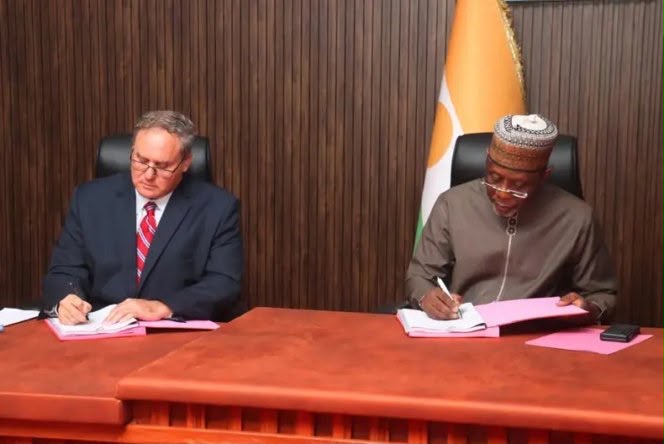
The government of Niger has officially executed a $1.9 billion agreement with Canadian industrial energy group Zimar Inc. and its partner High Tech to finance, design, build, and operate a 100,000-barrel-per-day refinery and integrated petrochemical complex in the southwestern city of Dosso. Once operational, the facility will rank as West Africa’s third-largest refining complex, positioned behind Nigeria’s Dangote Refinery and Ghana’s Sentuo Oil Refinery. The signing ceremony, held in the capital Niamey, formalizes a 16-year Public-Private Partnership structured strictly under a Build-Operate-Transfer framework.
Under the contract terms, Zimar Inc. will oversee three years of construction followed by 13 years of commercial operations before transferring full ownership of the infrastructure to the Nigerien state. The developer has been granted a four-month window to arrange financing and complete detailed engineering, with formal financial close targeted within 12 months. The megaproject represents a fivefold expansion over Niger’s existing refining capacity, as the country’s sole operational refining asset the Société de Raffinage de Zinder (SORAZ) currently processes just 20,000 barrels per day.

The complete Dosso setup will feature an integrated processing plant, connecting pipelines, storage tanks, and a petrochemical unit designed to yield essential manufacturing feedstocks

The agreement marks a pivotal step in Niger’s strategy to capture downstream economic value from its estimated three billion barrels of proven crude oil reserves. By refining raw crude domestically, the landlocked nation aims to eliminate its reliance on costly fuel imports, insulate its economy from regional supply volatility, and position itself as a net exporter of refined products.
Nigerien Foreign Minister Bakary Yaou Sangaré emphasized during the signing that the project converts natural resource production directly into local industrial capacity and establishes a long-term role in regional energy sovereignty.
Furthermore, the planned surplus output from Dosso is slated to supply neighboring landlocked states within the Alliance of Sahel States, fundamentally altering energy trade flows across interior West Africa.
RELATED: