Faith Nyasuguta

Ethiopia has closed its embassy in Eritrea and declared 10 Eritrean diplomats persona non grata, ordering them to leave the country within 48 hours as relations between the two Horn of Africa neighbours deteriorate amid renewed fighting in northern Ethiopia.
The decision, announced by Ethiopia’s Ministry of Foreign Affairs on October 1, 2026, marks one of the sharpest reversals since the two countries restored diplomatic relations eight years ago. Addis Ababa accused Eritrea of “direct and indirect acts of hostility and belligerence” and said the expelled diplomats had been involved in activities posing a “direct threat” to Ethiopia’s national security, allegedly in breach of the Vienna Convention on Diplomatic Relations. Ethiopia did not publicly provide details of the alleged activities.

The diplomatic crisis is unfolding alongside renewed fighting in Tigray, the northern Ethiopian region that was at the centre of the devastating 2020–2022 war.

“Persona Non Grata”

The phrase simply means that a country has formally declared a foreign diplomat unwelcome. Under international diplomatic practice, a receiving country can declare a diplomat persona non grata without necessarily having to publicly disclose all the evidence behind its decision. The diplomat is then expected to leave the country within the period specified.
In this case, Ethiopia gave the 10 Eritrean diplomats 48 hours.The closure of Ethiopia’s embassy in Asmara is a separate but related measure. It means Ethiopia is withdrawing its official diplomatic mission from Eritrea, reducing one of the main channels through which the two governments communicate. And the consequences have already gone further.

On October 1, Eritrea responded by saying it had no option but to sever diplomatic ties with Ethiopia, effectively closing its embassy in Addis Ababa as well. That transforms what began as an Ethiopian diplomatic measure into a much wider rupture between the neighbouring states.
War To Peace & Back Again
To understand why this matters, it is necessary to go back to 1998. Ethiopia and Eritrea fought a major border war from 1998 to 2000, with tens of thousands of people killed. Although a peace agreement ended the fighting, relations remained hostile for almost two decades.
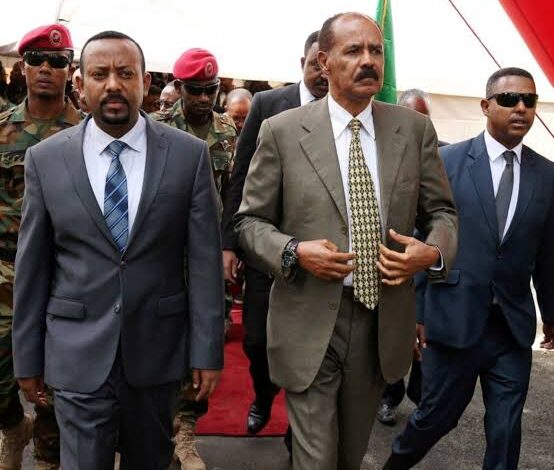
The breakthrough came in 2018, when Ethiopian Prime Minister Abiy Ahmed travelled to Eritrea and met President Isaias Afwerki.The two governments signed a Joint Declaration of Peace and Friendship, reopening diplomatic relations and restoring links that had been severed during years of hostility. The African Union welcomed the reconciliation as an important step towards regional peace.
The rapprochement was internationally celebrated. Abiy was awarded the 2019 Nobel Peace Prize, with the Norwegian Nobel Committee specifically recognising his efforts to achieve peace and international cooperation, particularly his initiative to resolve the border conflict with Eritrea. But the peace did not produce a lasting strategic partnership.
Tigray War
In November 2020, conflict erupted between Ethiopia’s federal government and the Tigray People’s Liberation Front (TPLF), which had dominated Ethiopian politics for decades before Abiy came to power. Eritrean forces entered the conflict and fought alongside Ethiopian federal forces against the TPLF.
The war lasted roughly two years and caused enormous humanitarian suffering, including mass displacement, widespread destruction and severe restrictions on humanitarian access. A peace agreement was signed in Pretoria, South Africa, in November 2022, bringing the major phase of the war to an end.
But Eritrea was not a party to the Pretoria agreement. That became an important weakness in the post-war settlement. Although the federal government and TPLF entered a formal peace process, questions involving Eritrea, border territories, security arrangements and the future political balance in northern Ethiopia remained unresolved.
Why Are Relations Collapsing Again?
The immediate crisis is linked to renewed fighting in northern Ethiopia. Ethiopia says Eritrea has engaged in hostile activities and has accused Asmara of supporting forces opposed to the federal government. Eritrea has rejected accusations that it is backing armed opposition groups against Addis Ababa. Ethiopia has also accused Sudan and Egypt of supporting opposition forces; all three countries have denied the allegations.
The security situation has become increasingly complicated because the TPLF has joined a wider coalition of armed and opposition groups seeking to remove Prime Minister Abiy Ahmed’s government. The renewed fighting has raised fears that Ethiopia could be sliding back towards a wider conflict only four years after the previous war ended.
Outlets reported that explosions were heard in Addis Ababa overnight around the time of the diplomatic escalation. An opposition source claimed responsibility for drone strikes targeting military facilities, although that claim could not immediately be independently verified.
The United Nations and African Union now face the difficult task of preventing a domestic Ethiopian conflict from developing into a wider regional crisis.
The Red Sea Question
There is another strategic issue behind Ethiopia-Eritrea tensions: access to the Red Sea.Ethiopia is landlocked and has increasingly described reliable maritime access as a strategic national priority. Eritrea, meanwhile, controls a long Red Sea coastline, including the port of Assab.
Any suggestion that Ethiopia could obtain sovereign control over Eritrean territory or coastline has been strongly opposed by Asmara. That makes maritime access an extremely sensitive issue between the two governments.
Ethiopia’s interest in Red Sea access also matters beyond its relationship with Eritrea because the Horn of Africa sits along one of the world’s most important maritime corridors, connecting the Red Sea to the Gulf of Aden and the Indian Ocean.
Implications
The embassy closure may look like a diplomatic story, but its implications are much bigger. Ethiopia and Eritrea sit at the heart of the Horn of Africa, a region already affected by conflicts in Sudan and Somalia, disputes over the Red Sea and competition involving Egypt, Gulf states and other external powers.
A new Ethiopia-Eritrea confrontation could therefore affect trade routes, border communities, refugees and regional security. It could also undermine the gains made by the 2018 peace process.
For Ethiopia, the immediate challenge is containing renewed armed conflict while preventing additional countries from becoming involved. For Eritrea, the severing of diplomatic relations further isolates a government that has long maintained a highly controlled political and security system.
And for the wider region, the lesson is uncomfortable: ending a war does not automatically resolve the political disputes that produced it. The 2018 reconciliation showed that former enemies can restore diplomatic ties. The events of 2026 show how quickly those gains can unravel when unresolved security, territorial and political questions return.
For now, Ethiopia says it remains committed to peaceful coexistence and regional integration, even as it closes its embassy in Asmara. The African Union has urged Ethiopia, Eritrea and other involved states to exercise maximum restraint and resolve their differences through established diplomatic channels and peaceful dialogue.
RELATED: