Faith Nyasuguta

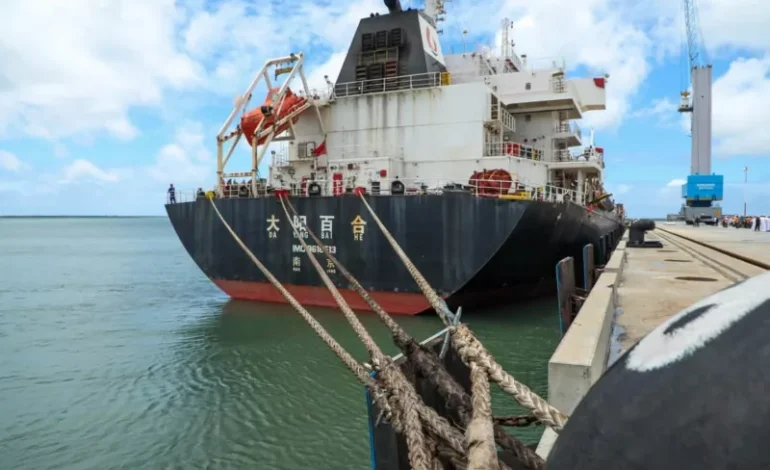
Kenya’s proposed Dangote East Africa Refinery has reached a significant physical milestone, with the first major shipment of construction equipment arriving at the Port of Lamu ahead of the planned groundbreaking on September 30. The vessel MV Da Yang Bai He docked at Lamu on September 26 carrying 2,930.295 metric tonnes of heavy machinery and construction materials for the project.
Kenya Ports Authority received the cargo, marking the first vessel specifically linked to the refinery’s construction. The development matters because the project has been discussed for months as an investment ambition; the arrival of equipment provides tangible evidence that preparations are moving into a new phase.

The planned refinery and petrochemical complex is estimated at roughly $15 billion–$17 billion, with Kenyan government and project reports commonly using the $17 billion figure, equivalent to about KSh2.2 trillion at current exchange rates. Dangote’s planned facility is designed to process 700,000 barrels of crude oil per day, which would make it one of Africa’s largest refining projects and substantially larger than Kenya’s former refinery at Mombasa, which stopped refining crude in 2013.

The project is intended to supply refined petroleum products to Kenya and neighbouring markets, potentially including Uganda, Rwanda, Burundi, South Sudan and the Democratic Republic of Congo.

Why The Machinery Matters
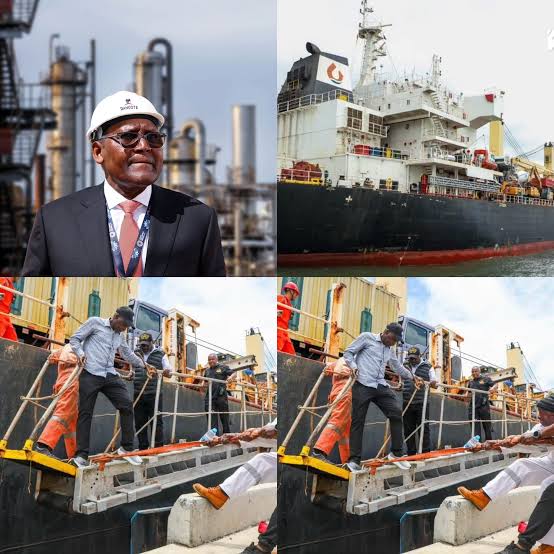
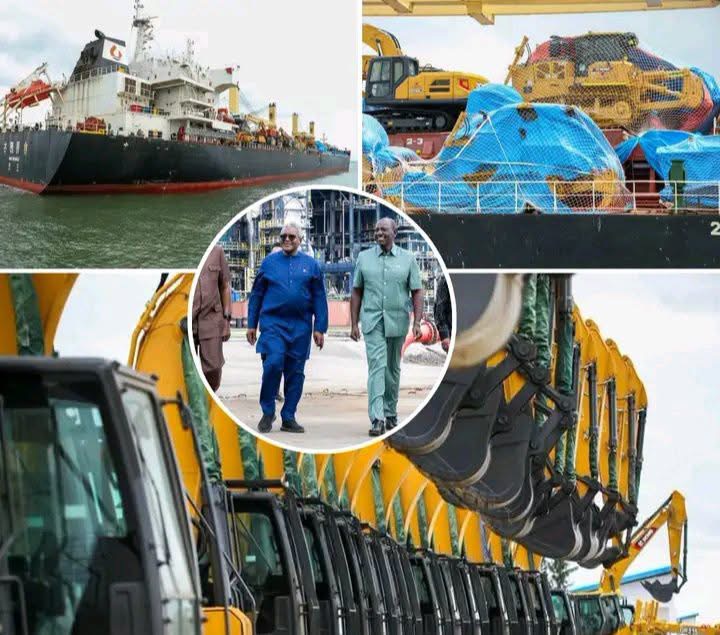
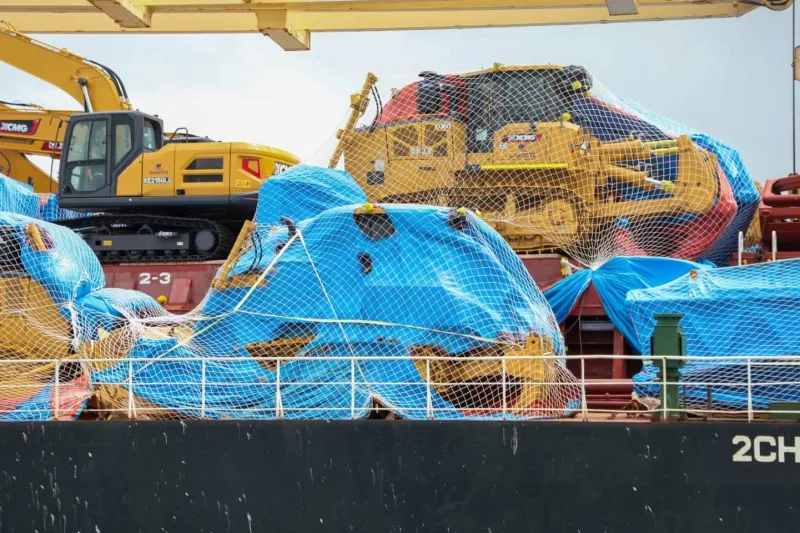
A refinery of this scale cannot be built like an ordinary industrial plant. It requires enormous quantities of specialised equipment, including processing units, storage systems, piping, electrical infrastructure, compressors, boilers and other heavy industrial components. The 2,930-tonne shipment is therefore not the refinery itself, but the beginning of a much larger logistics operation that will involve repeated deliveries through Lamu.

Kenya Ports Authority Managing Director Captain William Kipkemboi Ruto described the vessel’s arrival as a milestone demonstrating Lamu Port’s ability to handle large industrial cargo. He said the successful docking “firmly established the facility’s industrial growth and ability to handle ultra-large vessels.”
That is particularly important for Lamu Port, which has struggled to attract the level of commercial activity originally envisioned when it was developed. The port is the maritime anchor of the Lamu Port-South Sudan-Ethiopia Transport Corridor (LAPSSET), a regional infrastructure programme conceived in 2012 to connect Kenya’s Indian Ocean coast with Ethiopia and South Sudan through roads, railways, pipelines, airports and other infrastructure.
The original LAPSSET programme was estimated at about $29 billion, but progress has been slower than initially projected. Only three of the planned 24 Lamu port berths have been completed so far, according to The EastAfrican. A refinery of this scale could therefore provide Lamu with one of the major industrial anchors it has long needed.
Why East Africa Needs More Refining Capacity
The refinery is being proposed against a fundamental weakness in East Africa’s energy system: the region consumes large quantities of petroleum products but remains heavily dependent on imports. Kenya itself imports refined products, while landlocked countries such as Uganda, Rwanda, Burundi and parts of the DRC depend on imported fuel transported through lengthy supply chains. Fuel can arrive by sea and then travel hundreds or thousands of kilometres by road or pipeline before reaching consumers.
That dependence leaves the region vulnerable to international oil prices, shipping costs, exchange-rate movements, geopolitical disruptions and problems along transport corridors. Kenya’s former refinery at Mombasa, operated by the Kenya Petroleum Refineries Ltd, stopped refining crude in 2013 and subsequently became primarily a storage and fuel-handling facility. Since then, Kenya has increasingly relied on imported refined petroleum products. A functioning refinery at Lamu would therefore represent a major change in the country’s downstream petroleum infrastructure.
The proposed plant is also designed to serve a market much larger than Kenya. Engineers India Limited, the Indian state-owned engineering company appointed to manage the project, said the complex is expected to strengthen fuel production in East Africa, reduce dependence on imports and improve regional energy security. EIL has been awarded a contract worth more than $450 million to act as project management consultant and engineering, procurement and construction management consultant. Its involvement is significant because the company performed similar roles in the development of Dangote’s Lagos refinery.
The Dangote Model
The Lamu project is closely connected to Dangote’s larger strategy of building industrial infrastructure across Africa. His flagship refinery in Lagos began operations after years of construction and investment and has a planned capacity of about 650,000 barrels per day, with an expansion programme targeting 1.4 million barrels per day by 2029. The company has increasingly positioned the Nigerian facility not only as a source of fuel for Nigeria but as a potential supplier to other African and international markets.
The Lamu project takes that model into East Africa. Instead of exporting crude and importing finished products, the broader idea is to bring crude into a coastal refinery, process it closer to consumers and distribute petroleum products into regional markets. The location at Lamu gives the project direct access to the Indian Ocean, meaning crude can also be imported by sea if regional crude supplies are insufficient.
This is important because feedstock remains one of the project’s biggest questions. Kenya does not currently have commercial-scale crude production. Uganda is preparing to begin oil production, but its crude is tied to the East African Crude Oil Pipeline to Tanzania, while South Sudan’s potential contribution faces its own infrastructure and security challenges. Recent reporting indicates that Uganda has not committed its crude to the Lamu refinery and is instead focusing on refinery projects in Uganda and Tanzania. That means the Lamu facility may have to rely substantially on imported crude, at least initially.
East Africa’s Refinery Race
The Lamu project is also emerging in a region where countries are increasingly competing to become energy and logistics hubs. Uganda is developing the 60,000-barrel-per-day Hoima refinery, while Tanzania is pursuing a much larger energy complex linked to Uganda’s crude exports through the EACOP system. The planned Tanzanian project has been reported at around $20 billion, creating a significant competing refining and energy hub on the Indian Ocean.
That competition does not necessarily mean East Africa cannot support several refineries. The region imports enormous volumes of petroleum products, and demand is expected to remain significant because of transport, manufacturing, aviation and industrial activity. But each refinery needs reliable crude, financing, storage, transport networks and customers. The success of Lamu will therefore depend on whether Dangote can secure those pieces simultaneously rather than simply completing the physical plant.
Kenya’s Big Bet On Lamu
For Kenya, the stakes extend beyond fuel. A refinery of this size could create demand for port services, engineering, construction, logistics, storage, accommodation and other businesses around Lamu. President William Ruto has presented the investment as part of a broader effort to turn Kenya into a regional industrial and energy hub. On September 25, the president toured Dangote’s Lagos refinery ahead of the Lamu groundbreaking, giving him a first-hand look at the industrial model Kenya hopes to replicate.
The government has also projected significant employment and wider economic benefits from the project, although those projections should be treated as forecasts rather than guaranteed outcomes. The refinery could also increase activity at Lamu Port and strengthen the economic case for additional LAPSSET infrastructure.
But there is an important local issue that cannot be ignored. More than 130 Lamu residents have gone to court over land earmarked for the project, claiming customary and ancestral interests and seeking intervention over compensation and ownership concerns. On September 25, the Environment and Land Court ordered parties to maintain the status quo over the disputed parcel. The legal dispute means the project’s progress must be considered alongside questions about land rights, consultation and compensation for affected communities.
Ground-breaking to Production
The September 30 ceremony will be important, but it should not be confused with completion. A groundbreaking marks the formal beginning of construction; it does not mean the refinery will immediately produce fuel. A complex capable of processing 700,000 barrels a day requires years of engineering, equipment installation, testing, commissioning and development of supporting infrastructure.
For now, however, the arrival of 2,930 tonnes of machinery represents a clear shift. The project has moved from announcements and investment discussions into physical mobilisation.
If completed at its planned scale, the Lamu refinery could fundamentally change East Africa’s petroleum map. It could give Kenya a major refining base, provide a new industrial role for Lamu Port, strengthen the LAPSSET corridor and create another regional source of petrol, diesel, jet fuel and petrochemical products.
Refining crude inside Africa is only half the industrialisation story. The real transformation comes when refining is connected to ports, pipelines, storage, manufacturing, transport and regional markets. Dangote is attempting to build that entire chain in East Africa, and the first 2,930 tonnes arriving at Lamu are the first physical pieces of that much larger ambition.
RELATED: