Faith Nyasuguta

Nigeria is facing a growing contradiction at the heart of its oil industry – shipping out millions of barrels of crude while its largest refinery fights to stay fully operational.
New data shows the country exported 55.39 million barrels of crude oil in just the first two months of 2026, even as domestic refining capacity -led by the massive Dangote Petroleum Refinery – continues to face severe supply shortages.

Figures from the Central Bank of Nigeria reveal that exports hit 31.31 million barrels in January and 24.08 million in February. During the same period, total production stood at 81.94 million barrels, leaving only 26.55 million barrels available for local refining.

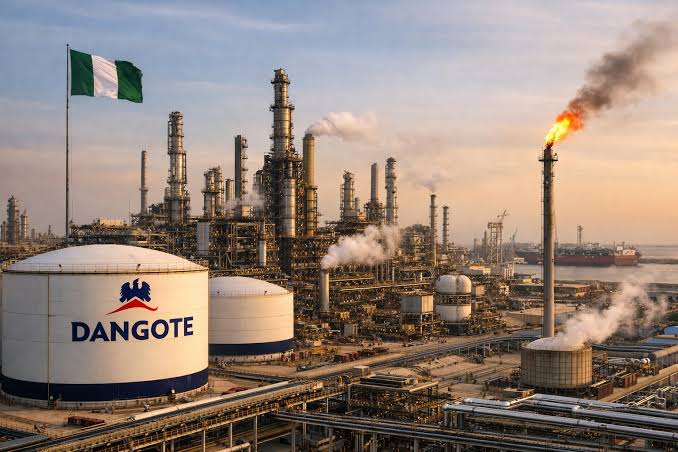
That imbalance is now raising serious questions. Despite being Africa’s largest oil producer, Nigeria is struggling to feed its own refining ambitions. At the centre of the crisis is the $20 billion Dangote refinery in Lekki, designed to process 650,000 barrels per day – a project meant to end the country’s reliance on fuel imports.


Instead, the refinery is operating below capacity due to insufficient crude supply from domestic producers. Between October 2025 and mid-March 2026, the facility reportedly faced a staggering 79.53 million barrel shortfall. To run at full capacity, it requires nearly 19.77 million barrels per month – but actual deliveries have consistently fallen far short.
Monthly supply figures paint a stark picture: 4.55 million barrels in October, 6.45 million in November, 4.30 million in December, 5.65 million in January, and 4.66 million in February. Even with a slight uptick to 10 cargoes in March, the refinery is still receiving far less than the estimated 13 cargoes needed monthly.

This translates to roughly 26.9% of required supply, forcing the refinery to turn to international markets for crude – an ironic twist for a country with abundant oil reserves.
The strain is already being felt by consumers. Petrol prices have surged past 1,300 Naira per litre before easing slightly to around 1,250 Naira, reflecting ongoing volatility tied to supply constraints. The refinery has blamed these fluctuations on inconsistent domestic allocations and the need to import crude at global market rates.
The situation persists despite the government’s “naira-for-crude” policy, designed to prioritise local refineries. Industry insiders argue that implementation gaps have allowed a significant share of Nigeria’s crude to continue flowing to export markets instead.
For its part, the Nigerian National Petroleum Company Limited says it is working to close the gap by sourcing crude internationally. Officials point to existing export commitments and legacy contracts as factors limiting immediate domestic supply, while insisting that efforts are underway to support local refining.
Still, stakeholders are sounding the alarm. Industry groups warn that without consistent feedstock, Nigeria risks undermining one of its most ambitious industrial projects. The Crude Oil Refiners Association has called for a rebalancing of allocations to ensure domestic refineries receive priority access.

At its core, the issue reflects a deeper tension: Nigeria’s dependence on oil export revenues versus its push for self-sufficiency in refining.
For now, the numbers tell a blunt story – millions of barrels leaving the country, while one of Africa’s largest refineries waits for the crude it was built to process.
RELATED: