Faith Nyasuguta

Nigeria’s Dangote Group is moving ahead with the planned groundbreaking of its proposed 700,000-barrel-per-day oil refinery in Lamu, Kenya, despite a court order over land rights that could restrict activities at the project site. The Malindi Environment and Land Court ordered parties to maintain the “status quo prevailing” on a disputed parcel until October 14, when the case will be heard between the parties.
The order, issued on September 25 and made public this week, follows a petition by 133 residents of Chandavai who say the land is ancestral property that their families have occupied and farmed for generations.

The immediate distinction is important: the court did not grant the residents’ request to stop the groundbreaking ceremony itself. Justice Jane Onyango declined to certify the application as urgent and directed the respondents to file their responses within 14 days, with the inter partes hearing scheduled for October 14.

At the same time, the interim order requires the existing condition of the disputed land to be preserved, meaning activities that could alter it may be restricted while the case is pending. Local reporting says the restrictions cover activities such as clearing, excavation, fencing, demolition, construction or other interference with the affected portions.

Dangote Group therefore says the ceremony scheduled for September 30 will proceed, although actual work on parts of the site could be affected. In a statement, the company said: “The court has not halted the groundbreaking ceremony of the refinery at this stage.” It added that site activities could be affected because the parties are required not to undertake activities on the disputed land before the October 14 hearing. The position means Wednesday’s event can mark the formal launch of the project without necessarily allowing full construction activity to proceed on every part of the contested site.
Why The Land Case Matters

The dispute goes beyond a disagreement over a piece of property. The 133 Chandavai residents argue that the land is part of their ancestral heritage and that families have lived, farmed and maintained community connections there for generations. Reports on the case say the petitioners have raised concerns about eviction, destruction of property and the adequacy of arrangements for people affected by the project.
They have also challenged aspects of the project’s approvals and public participation. These claims are allegations before the court, not findings that have been established against Dangote or the Kenyan government.
That makes the October 14 hearing particularly important. Large infrastructure projects in Kenya can involve competing interests between national development objectives, private investment, environmental requirements and community land rights. The court process will determine how the competing claims over the disputed parcel are handled.
For Dangote, resolving the land question is essential because a refinery of this scale cannot be built simply by securing billions of dollars in financing; the company also needs secure land tenure, regulatory approvals, community acceptance and uninterrupted access to the construction site.
A $15–16 Billion Bet On East Africa
The proposed refinery is one of the largest industrial investments ever contemplated for Kenya. Dangote has put the expected cost at $15 billion to $16 billion, with completion targeted for around 2030. Its planned capacity of 700,000 barrels per day would make it one of Africa’s largest refining facilities and would replicate the capacity of the Dangote refinery near Lagos, Nigeria. The Kenyan project is also expected to include petrochemical-related industries, expanding the ambition beyond simply producing petrol and diesel.
The scale becomes clearer when compared with Kenya’s existing petroleum market. Kenya’s National Petroleum Policy says the country stopped processing crude at the Kenya Petroleum Refineries Limited facility in 2013 and subsequently became fully dependent on imported petroleum products. By March 2025, monthly petroleum-product imports were approximately 490,000 metric tonnes, equivalent to about 5.9 million tonnes annually.
A 700,000-bpd refinery would therefore be far larger than Kenya’s domestic requirements alone. That is deliberate. The business case is based on supplying a wider East African market, potentially turning Lamu into a regional petroleum-processing and distribution hub rather than building a refinery solely for Kenyan consumption. East Africa’s demand for fuel has continued to grow alongside transport, manufacturing, construction and urbanisation, while countries without refineries remain exposed to international prices, shipping costs, exchange rates and disruptions to global supply chains.
Kenya’s Cruse Problem
There is, however, another major issue: Kenya does not currently have commercial oil production. This creates a fundamental question about where a refinery capable of processing 700,000 barrels of crude every day would obtain its feedstock.
Potential supplies could come from producers elsewhere in East Africa, including Uganda and South Sudan, while Kenya could potentially develop its own production in the future. But moving crude from landlocked Uganda or South Sudan to Lamu requires major pipeline and logistics infrastructure. Crude supply has been identified as one of the central challenges facing the project, alongside financing, infrastructure and regulatory requirements.
This is where the refinery intersects with the broader Lamu Port-South Sudan-Ethiopia Transport corridor, commonly known as LAPSSET. The vision is to use Lamu as a gateway connecting Kenya’s coast with inland markets and neighbouring countries. A major refinery would give that corridor another strategic component: instead of Lamu simply receiving and exporting goods, it could become a centre for transforming imported or regional crude into higher-value petroleum products.
The Dangote Model
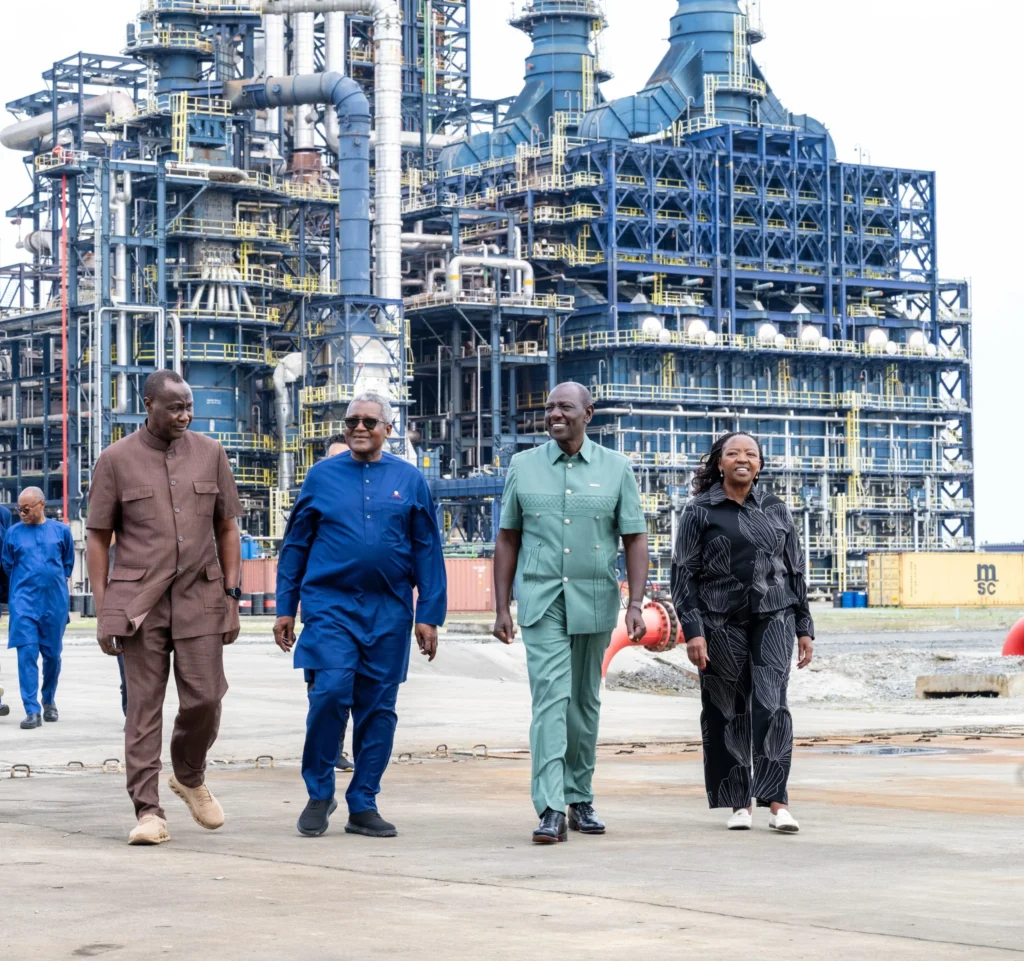
The project is heavily influenced by what Dangote has achieved in Nigeria. The Dangote refinery near Lagos has a nameplate capacity of 700,000 barrels per day and has helped Nigeria reduce its historic dependence on imported refined fuel while enabling the country to become a growing exporter of petroleum products.
Dangote is attempting to reproduce that model on a regional scale in East Africa. Rather than simply investing in another refinery, the group is positioning Lamu as part of a broader African industrial network involving refining, storage, transportation, petrochemicals and regional fuel distribution.
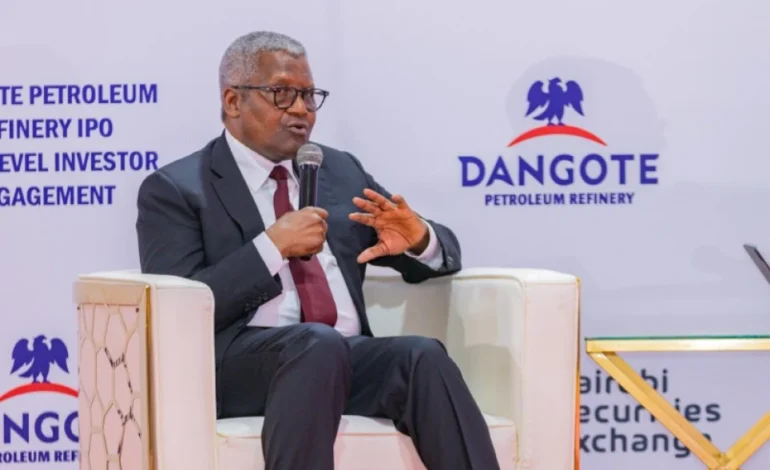
Speaking in Nairobi ahead of the groundbreaking, Aliko Dangote acknowledged the court development but expressed confidence in the project. “This is normal for us in Africa. … In fact, this is even small,” he said, adding: “Anyone who wants to cause trouble, we are ready for them.” Those remarks reflect the group’s determination to proceed, but the legal process remains separate from the company’s confidence about the project’s future.
What is at Stake For Kenya?
If completed, the refinery could fundamentally change Kenya’s position in the regional energy market. It could reduce dependence on imported finished petroleum products, create a large industrial base around Lamu and provide fuel to neighbouring economies. The project is expected to generate more than 50,000 jobs, while other estimates mention about 60,000 jobs, illustrating that employment figures remain projections rather than guaranteed outcomes.
But the economic opportunity comes with equally important obligations. A project of this magnitude must address land rights, environmental protection, community compensation and resettlement, infrastructure and crude supply. Lamu also contains the historic Lamu Old Town, a UNESCO World Heritage site, adding another layer of environmental and cultural sensitivity around major development in the region.
The September 30 groundbreaking is therefore only the beginning. It will proceed as a ceremony, but the October 14 court hearing will provide an important test of whether construction can move forward on the disputed land.
For Kenya, Dangote’s refinery represents an extraordinary industrial opportunity; for the affected Chandavai residents, the question is whether that development can proceed while their land and legal rights are protected. How those two priorities are reconciled could ultimately be just as important as the refinery’s $16 billion price tag.
RELATED: