Wayne Lumbasi

South Africa’s labor market crisis deepened in the second quarter of the year, with the official unemployment rate climbing by 0.9 percentage points to 33.6%, up from 32.7% in the first quarter. According to the latest Quarterly Labor Force Survey published by Statistics South Africa, the total number of unemployed individuals rose by 345,000 between April and June to reach 8.5 million. Over the same period, total employment edged down by 16,000 to 16.7 million, highlighting a persistent economic inability to generate sufficient opportunities for a growing pool of job seekers.
The primary driver behind the surge in official unemployment was a significant influx of individuals returning to the active workforce. The total active labor force expanded by 329,000 people to approximately 25.22 million during the quarter.

Concurrently, the number of discouraged job seekers, those who had previously given up looking for work fell by 227,000 to 3.7 million as more individuals resumed active job searches. However, because the broader economy failed to absorb these returning workers, the expanded unemployment rate, which includes those who are discouraged from seeking work, edged up to 43.8%. Meanwhile, the composite measure of labor under utilization remained stagnant at 46.3%.

Job losses were spread across seven of the ten main economic industries, with public services and primary industries taking the largest hits. The community and social services sector recorded the largest contraction, dropping 57,000 positions, followed by declines in mining (-26,000), agriculture (-15,000), and manufacturing (-15,000). These losses were partially offset by modest hiring in trade (+70,000), construction (+39,000), and finance (+11,000).

Formal sector employment shrank by 41,000 overall, whereas informal employment showed minor resilience by adding 34,000 jobs.
Regional performance diverged sharply across the country’s nine provinces. The Western Cape experienced the largest net reduction in employment, losing 48,000 jobs, followed by Gauteng with a drop of 22,000 and North West with 15,000. Conversely, Mpumalanga recorded the highest quarterly gains, adding 41,000 jobs, alongside smaller increases in the Eastern Cape and Free State.

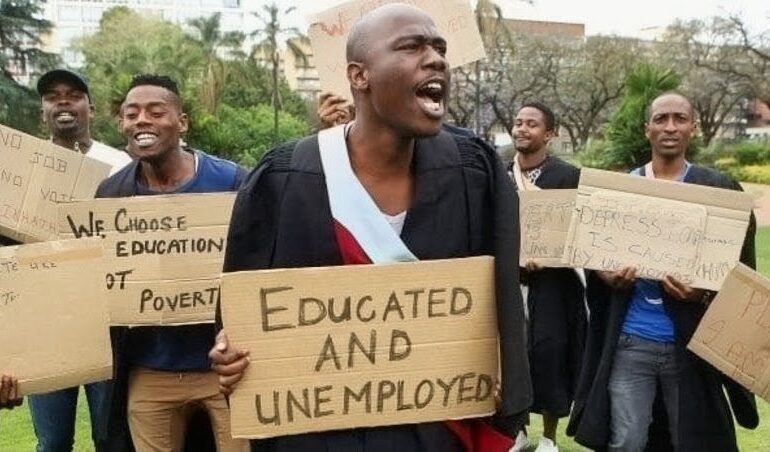
Demographically, young South Africans continue to bear the brunt of the nation’s economic inertia. The unemployment rate for youth aged 15 to 34 jumped by 1.5 percentage points to 47.4%, worsening an already acute social challenge. Economists attribute the ongoing stagnation to persistent global headwinds, high domestic operating costs, and lingering infrastructural bottlenecks that continue to suppress private sector investment and hiring confidence.
Young people and Black women remain the hardest hit by unemployment in South Africa, where the coalition government formed in 2024 has struggled to boost job creation despite economic reforms and modest growth
RELATED