Wayne Lumbasi

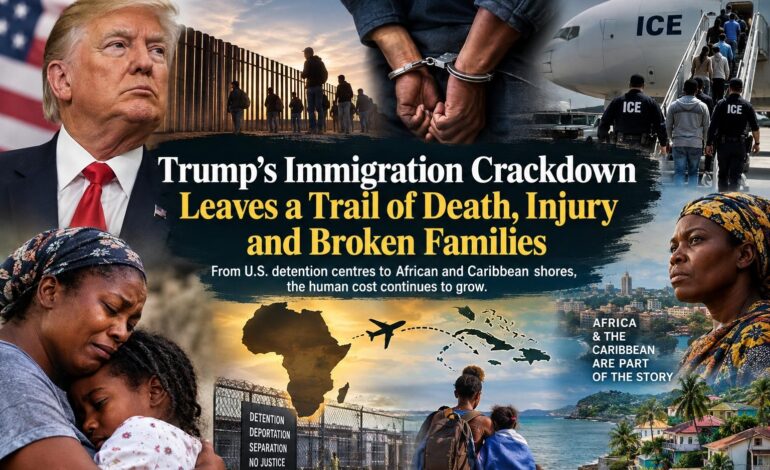
President Donald Trump’s sweeping immigration crackdown is leaving a growing trail of deaths, injuries, detention and broken families across the United States, while its consequences are increasingly being felt far beyond American borders. What began as a campaign promise to carry out mass deportations has developed into an expansive enforcement system involving larger detention populations, aggressive arrests inside communities, increased use of force and a growing network of third-country deportation arrangements that are drawing African and Caribbean nations directly into the consequences of America’s immigration policy.
The human cost is becoming increasingly difficult to separate from the policy itself. At least 52 people died in Immigration and Customs Enforcement custody during the first 500 days of Trump’s second administration, through June 4, 2026, according to a review of detention deaths. The mortality rate in ICE custody has more than doubled since Trump returned to office and is now substantially higher than during either the Biden administration or Trump’s first term. The broader toll associated with immigration enforcement has also included people shot during encounters with federal agents, with at least 17 motorists shot during immigration operations since the beginning of Trump’s current term and six deaths recorded in those shootings by July.

The figures are particularly disturbing because the immigration detention population has expanded at the same time. More than 70,000 people were held in ICE custody at the height of the expansion, turning detention facilities into a vast parallel system through which tens of thousands of people are passing. Human rights investigators have raised concerns about medical care, conditions inside facilities and the quality of government oversight, arguing that the increase in deaths cannot simply be explained by the increase in the number of people detained.

Human Beings Behind Every Number

For families, a death in immigration custody is not a statistic about government enforcement. It is the loss of a husband, wife, son, daughter or parent, often after the person had been taken into a system where the family had little control over what happened next. One documented case involved Maksym Chernyak, a 44-year-old Ukrainian national who suffered a stroke after showing clear signs of a medical emergency while in detention. A review of his case found that detention staff witnessed warning signs but that there were delays in transferring him to higher-level medical care, delays that investigators concluded almost certainly contributed to his death. Another detainee, Lorenzo Antonio Batrez Vargas, died in custody after being diagnosed with Covid-19 and spending 12 days in isolation.
These cases expose the vulnerability created when the government takes control of a person’s movement, medical access and communication with relatives. Once inside detention, an immigrant cannot simply walk out to seek another doctor, return home to recover or ask a relative to intervene. The system controls the environment, and that makes accountability and transparency particularly important. Yet concerns have also been raised about the speed and completeness with which deaths are reported to families and the public, adding another layer of uncertainty for relatives already struggling to understand what has happened to their loved ones.

The consequences become even more painful when detention turns into separation. Immigration enforcement under Trump has increasingly affected parents of American children, creating a quieter but widespread form of family separation that does not necessarily occur at the border. Data from the first months of the administration showed that ICE had detained the parents of more than 11,000 US-citizen children. Because American children cannot themselves be detained or deported with their parents, an arrest or deportation can leave the child with relatives, friends or other caregivers while the parent remains in custody or is removed from the country.
For a child, however, the legal distinction between immigration status and citizenship does not make the separation less painful. A parent who disappears into detention is still a parent who is no longer at home. The child still loses daily contact, financial support, protection and emotional security. In mixed-status families, one member can have the full legal right to remain in the United States while another is removed, creating a situation where citizenship protects the child but cannot necessarily prevent the family from being divided.
When Enforcement Enters Community
The immigration crackdown has also changed the nature of encounters between federal agents and immigrant communities. Immigration enforcement is no longer experienced only through border patrols or formal deportation proceedings. Agents are conducting arrests inside communities and, in some cases, attempting to stop people in vehicles. Those encounters have produced fatal shootings, including incidents in which immigration officers opened fire during vehicle-related operations. In July, ICE temporarily halted most traffic-stop arrests following two fatal shootings within a single week, before the administration moved to resume the tactic.
The most recent incidents have intensified questions about the use of force and the degree of accountability surrounding federal immigration operations. In September, an ICE agent shot and wounded Venezuelan national Wilber Rafael Garces Perez in Austin, Texas, during a brief foot pursuit. Perez was hospitalised and later returned to ICE custody. His lawyer disputed the government’s account of his immigration status and the circumstances leading to the shooting, while federal authorities said the incident was under investigation.
The importance of such cases goes beyond the individual circumstances. When an immigration encounter results in serious injury or death, questions arise about what happened before force was used, whether alternatives existed, whether officers followed their training and whether evidence such as body-camera footage is available. These questions become more difficult when immigration agencies are simultaneously responsible for conducting the operation and defending their officers’ actions.
Africa Part Of The System
Perhaps the most significant development for Africa is the administration’s expansion of third-country deportations. Instead of returning migrants to their countries of nationality, the United States has increasingly negotiated arrangements under which deportees are sent to other countries. More than 100 people from Afghanistan, Cuba, Nicaragua and other countries were sent to eight African countries over a 10-day period in August, including Burundi, Cameroon, the Central African Republic, Equatorial Guinea, Eswatini, Liberia, Rwanda and Sierra Leone.
This represents a major shift in the geography of American deportation. A migrant can now leave the United States without going back to the country from which they originally came. Instead, they can arrive in an African country with which they have no family history, no established community and sometimes no previous connection whatsoever. The United States may regard the removal as completed once the person is transferred, but for the receiving country and the deportee, a new and uncertain chapter begins.
The arrangements have already produced serious human consequences. In one case involving a 28-year-old West African woman who had fled Togo because she feared female genital mutilation, a US immigration judge had ruled that she should not be returned directly to Togo.
She was instead sent to Ghana with other West Africans. After spending time in detention near Accra, she said armed guards took her and others to the Togolese border and left them there. Her ordeal illustrates how third-country deportation can create a route around protections that were intended to prevent a person from being returned to a place where they face persecution.
Ghana has become one of the African countries drawn into this system, and rights organisations have challenged the treatment of some deportees sent there. In cases involving people who had previously obtained protection from removal to their home countries, the concern is that transferring them first to another African country can ultimately expose them to the same danger that American immigration courts had recognised. That is why the issue has become not only an American immigration question but also an African human-rights and diplomatic issue.
Equatorial Guinea provides another troubling example. More than 40 people deported from the United States were sent there under an agreement with the Trump administration and held in a hotel converted into a detention centre. In September, Egyptian national Ahmed Soliman and Eritrean national Samson Birhane were arrested after raising concerns about their treatment. Their lawyers said the two men were blindfolded and beaten after being taken into police custody. The case demonstrates the danger of transferring people from one detention system into another without ensuring what protections and legal guarantees will exist after they arrive.
For African governments, the question is therefore becoming increasingly complicated. Accepting deportees may deepen diplomatic and economic relations with the United States, but it can also create responsibility for people who are not citizens and may have no meaningful connection to the country receiving them. Governments must then confront questions about detention, housing, healthcare, legal status and eventual resettlement. The responsibility does not disappear when the American aircraft leaves African airspace.
The Caribbean
The Caribbean is facing a different but closely connected consequence of Trump’s immigration agenda. Haiti, in particular, has become increasingly exposed to deportations as immigration protections for Haitians in the United States have been dismantled. Many of those being returned are people who spent years building their lives in America, working, raising children and establishing communities before suddenly finding themselves facing removal to a country experiencing severe insecurity and economic hardship.
For some Haitian families, deportation is therefore not simply a journey home. It can be the destruction of an established life. A person who has spent ten or fifteen years in the United States may have children who were born there, a spouse who remains there, a job they can no longer return to and no immediate means of rebuilding a life in Haiti. The legal decision may concern one individual, but the consequences spread across an entire family divided between two countries.
One particularly painful dimension involves children who remain in the United States after their parents are deported. American-born children can remain legally in the country while their parents are forced to leave, creating families that exist across borders against their will. The result is a form of separation that can continue long after the immigration case has been closed, because the parent may have no practical way of returning and the child may have no realistic way of relocating without abandoning school, family or citizenship rights.
The burden on Haiti also extends beyond individual families. Deportees need housing, food, healthcare, transportation, documentation and employment. A country already dealing with profound economic and security challenges must absorb additional people who may have limited resources and few connections to the local economy. The deportation decision is made in the United States, but the social cost is transferred to Haiti.
A System Becoming Harder To See
Another important part of the current immigration story is the growing difficulty families and lawyers face in locating detainees. In September, ICE stopped publicly listing the locations of thousands of detainees with final removal orders in its online detainee locator. Around 16,000 people detained in July had final removal orders, meaning the change could affect a significant number of people at the point when deportation becomes imminent. Lawyers have warned that not knowing where a detainee is being held can make emergency legal intervention considerably more difficult.
For an immigrant facing removal, location is not a minor administrative detail. It can determine whether a lawyer can reach them, whether a family member can visit them and whether a last-minute legal challenge can be filed. When a person disappears from a public system, the family may know that the government has custody of them but not know exactly where they are or how quickly they could be removed.
That concern becomes even more significant as third-country deportations expand. A migrant can move from an American detention centre to an airport and then into another country’s custody in a matter of hours. If legal representatives cannot locate the person quickly enough, the opportunity to challenge the removal can disappear before the case receives meaningful consideration.
African & Caribbean Connection
The emerging pattern has created a striking geographical chain. Immigration decisions are being made in the United States, detention is being carried out through a growing network of American facilities, deportation flights are leaving American soil and some of the people removed are ending up in African and Caribbean countries that must then deal with the consequences.
For Africa, this means the continent is no longer simply a source of migrants seeking opportunities in the United States. It is increasingly becoming part of the infrastructure through which the United States manages deportation. African countries are being asked to receive people from other continents, while African nationals themselves are being detained, deported and, in some cases, placed on routes that can eventually return them to countries they had fled.
For the Caribbean, the connection is even more personal because migration has produced generations of families divided between the islands and the United States. A deportation can therefore affect an entire transnational household. Money that once travelled from an American workplace to relatives in the Caribbean can stop. Children can lose a parent. Elderly relatives can lose caregivers. Communities that depend on remittances can lose an important source of support.
This is why the impact of Trump’s immigration policies cannot be measured only by the number of people deported. The true impact extends into family finances, childhood development, community stability, healthcare systems and the capacity of receiving countries to absorb people who have been removed from another society.
Accountability
The Trump administration maintains that it is enforcing immigration law and restoring control over a system it considers to have been too permissive. That authority to enforce immigration laws is not in dispute. The more difficult question is what safeguards should accompany that authority when the consequences include death, serious injury, detention without clear access to relatives and lawyers, and the separation of parents from children.
The scale of enforcement makes that question increasingly urgent. When tens of thousands of people are detained, even a small failure in medical care or oversight can have devastating consequences. When thousands of parents are arrested, the impact extends to children who have committed no immigration violation. When people are sent to third countries, the responsibility for their safety does not necessarily end when they leave American territory.
The courts are increasingly becoming an important check on some of these practices. In September, a federal appeals court rejected the administration’s policy of rapidly deporting people to third countries without giving them a meaningful opportunity to raise concerns about persecution or torture. The ruling came after more than 25,000 migrants had reportedly been sent to at least 29 third countries under the administration’s expanding programme.
But litigation does not immediately undo the human consequences of policies already carried out. A person who has already been deported cannot simply recover the years lost from their children. A family cannot undo the trauma of detention. A person injured during an enforcement operation cannot erase the physical consequences. And a family that has lost someone in custody cannot bring that person back.
That is ultimately the deeper story behind Trump’s immigration crackdown. It is not simply a story about borders, deportation statistics or political promises. It is a story about what happens to human beings when an immigration system is expanded at extraordinary speed and enforcement becomes the dominant instrument of policy.
The consequences are now visible in American detention centres, in families separated across states and countries, in immigrant communities living with fear of arrest and in African and Caribbean societies being asked to absorb people removed from the United States. They are visible in the death of detainees, the injuries suffered during enforcement encounters and the uncertainty faced by families trying to locate relatives inside a system that is becoming harder to penetrate.
For Africa and the Caribbean, the implications are particularly profound. A decision made in the United States can now determine whether a Haitian mother sees her children again, whether an African migrant is returned to a country from which they fled, or whether a person who has never lived in an African country suddenly finds themselves detained there.
The aircraft may leave the United States, but the consequences do not leave with it. They remain with the families, the children, the communities and the countries that must live with what the deportation system leaves behind.
Trump’s immigration crackdown has therefore created a trail that stretches well beyond the American border. It reaches into homes, detention centres, airports and foreign governments, carrying with it a human cost that can be counted in deaths and injuries but cannot be fully captured by statistics. The central question now is not simply how many people the United States can remove, but what responsibility a government carries for the human consequences of removing them.
RELATED: