Faith Nyasuguta

Sudan’s war has entered its fourth year, and what began as a power struggle between two armed forces has become one of the most devastating humanitarian disasters on the planet. Since fighting erupted on 15 April, 2023, civilians have been killed, raped, starved and displaced on a staggering scale, while entire cities and communities have been reduced to ruins.
At the centre of the conflict are the Sudanese Armed Forces (SAF), commanded by Abdel Fattah al-Burhan, and the Rapid Support Forces (RSF), led by Mohamed Hamdan Dagalo, commonly known as Hemedti. The two men were once partners in Sudan’s post-Omar al-Bashir political transition. Their forces instead turned on each other in April 2023 over power, control of the state and the proposed integration of the RSF into the regular army.

More than three years later, there is no reliable single death toll. The UN says the true number is likely in the hundreds of thousands. Different estimates vary enormously because fighting, displacement, destroyed records and restricted access make comprehensive counting almost impossible. One recent assessment put recorded conflict fatalities at about 52,900 by June 2026, while broader estimates have reached 150,000 or more. Aid workers have estimated that more than 200,000 people may have died. But the numbers that can be verified are horrific enough.

Between January and June 2026 alone, the UN human rights office documented about 1,400 civilian deaths, including approximately 1,100 people killed by drone strikes. The UN says both sides have repeatedly used drones against civilian areas, including markets, schools, fuel stations and water infrastructure. A separate UN fact-finding investigation reported that more than 1,000 people were killed in drone strikes during the first five months of 2026.

This is important because Sudan’s war is no longer simply a story of soldiers fighting soldiers. The technology of the conflict has changed. Foreign weapons, military technology, fighters and logistical networks have increased the ability of both sides to strike targets far from conventional front lines. The UN investigation said some attacks may constitute war crimes and called for the international arms embargo on Darfur to be expanded to the whole country.
And civilians are paying for that transformation.

Over 14 Million People Displaced
Sudan has produced one of the largest displacement crises in the world.
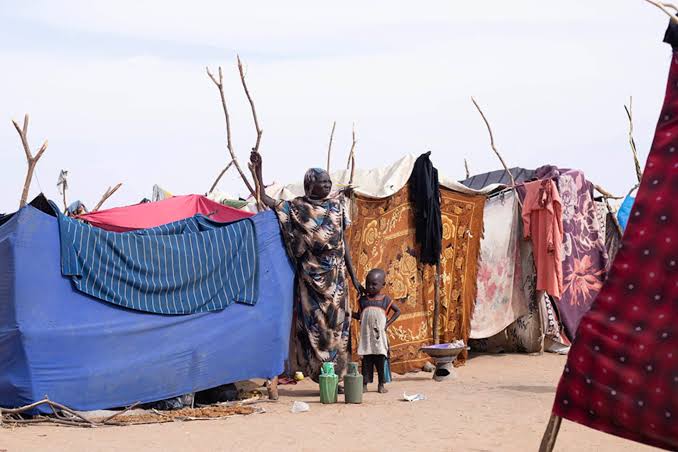
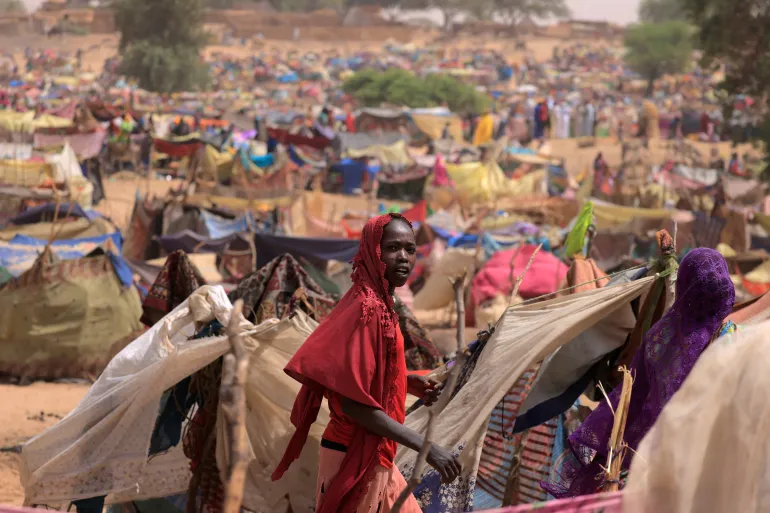
More than 13 million people had fled their homes by August 2026, according to the UN, including around 8.7 million internally displaced people spread across all 18 states. Millions more have crossed Sudan’s borders into neighbouring countries. By June, approximately 4.6 million people had been displaced outside Sudan since the war began.
That means displacement is not simply about people crossing a border and becoming refugees.
Millions remain trapped inside Sudan, repeatedly moving from one dangerous location to another. Others are returning to places where fighting has decreased, only to discover that their homes, schools, hospitals, water systems and livelihoods have been destroyed.
The UN estimates that Sudan remains the world’s largest displacement crisis, with nearly 9 million internally displaced people as of April 2026.
For Africa, this matters enormously. Sudan’s neighbours — Chad, Egypt, South Sudan, Ethiopia and the Central African Republic, among others — are absorbing people fleeing the conflict while dealing with their own economic and humanitarian pressures. The war therefore does not stop at Sudan’s borders.
Hunger
The war has also shattered Sudan’s food system. Farmers have been displaced. Fields cannot be cultivated safely. Roads and markets have been disrupted. Food prices have risen, while humanitarian agencies struggle to reach communities trapped by fighting.
According to the latest IPC analysis cited by the UK government, about 19.5 million people — roughly 41% of Sudan’s population — were experiencing acute food insecurity at Crisis level or worse in May 2026.
More than 5 million were classified in Emergency conditions, while approximately 135,000 people were facing Catastrophe-level hunger. Fourteen areas across North Darfur, South Darfur and South Kordofan were identified as being at risk of famine.
And hunger is not occurring in isolation.
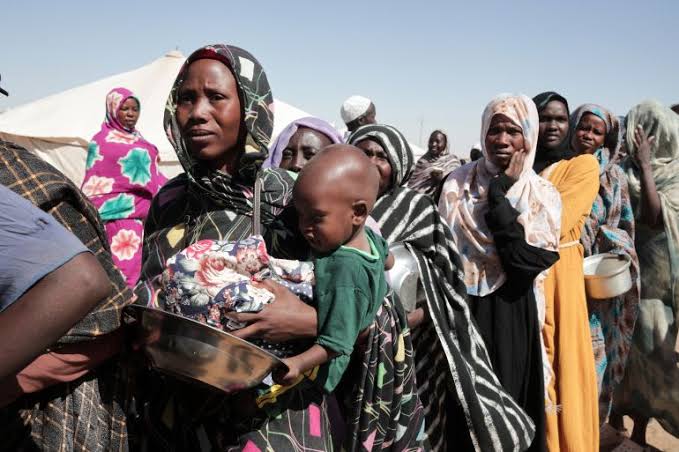
The WHO estimates that more than 4 million people were acutely malnourished in 2026, while disease outbreaks involving malaria, dengue, measles, polio, hepatitis E, meningitis and diphtheria have been reported.
This is what makes Sudan’s crisis so deadly: a person does not have to be shot to become a casualty of war. A child can die because a hospital has no electricity. A mother can lose her baby because there is no functioning maternity service. A family can become malnourished because the road carrying food into their town has been cut. A displaced person can die from disease because clean water and sanitation have collapsed.
Health Systems Crippled
The WHO says 21 million people lack adequate access to health services, while 37% of health facilities across Sudan’s 18 states remain non-functional.
WHO has verified 217 attacks on health care since 15 April 2023, resulting in 2,052 deaths and 810 injuries. Hospitals, ambulances, patients, medical workers and medical supplies have all been affected.
One of the most devastating examples came in East Darfur, where the El Daein Teaching Hospital was attacked, killing at least 64 people according to WHO’s April assessment and leaving the hospital non-functional. More recent UN investigations have also documented attacks on the facility, with the reported death toll reaching at least 70 in the UN fact-finding mission’s account.
The destruction of a hospital in Sudan therefore has consequences far beyond the people killed in the attack. It removes one of the few places thousands of other civilians could have turned to for emergency surgery, childbirth, trauma care, vaccination and treatment.
Sexual Violence Part Of The War Sudan’s crisis is also a gendered catastrophe. The UN has documented recurring patterns of rape, gang rape, abduction of women and girls and other forms of conflict-related sexual violence. By August 2026, the UN human rights office had documented 838 victims of sexual violence, almost all women and girls, while explicitly warning that the real number is likely far higher because survivors face enormous barriers to reporting.
In July, a UN investigation said RSF forces had carried out mass killings, abductions and mass rape during the siege and capture of El Fasher. The investigators concluded that some of the crimes against the non-Arab Zaghawa and Fur communities amounted to genocide. That is an especially grave legal finding, and it should be understood as a conclusion of the UN investigation rather than a general characterization of every event in Sudan.
El Fasher, Darfur & Old Wounds
Sudan’s current war also cannot be understood without understanding Darfur. The region was already scarred by the atrocities of the early 2000s. The RSF grew partly out of the Janjaweed militias associated with that period.
In October 2025, the RSF captured El Fasher, the capital of North Darfur, after a prolonged siege. International and local organisations reported mass killings and ethnically targeted violence following the city’s fall. The UN has since documented continuing atrocities and warned about the risk of further ethnic violence.
The conflict has subsequently shifted across Darfur, Kordofan and parts of Blue Nile, while violence has fallen in some areas such as Khartoum and Al Jazirah. But reduced fighting in one area does not mean Sudan has become safe. Returning families frequently find destroyed homes, unexploded weapons, damaged infrastructure and almost no services.
The danger can literally remain buried underground. Between January and June 2026, UNMAS recorded 108 people killed or injured in 38 explosive-ordnance accidents. Children accounted for 55% of victims whose ages were known.
Why Is It Getting Worse?
One major reason is that Sudan’s war has become more than a domestic confrontation. The UN says foreign weapons, technology, fighters and logistical networks are helping sustain the conflict. That means Sudan is also caught inside a wider regional and international struggle involving money, weapons, gold, strategic territory and competing geopolitical interests.
Gold is particularly important. Sudan is one of Africa’s major gold producers, and control over gold-producing areas has provided an important source of revenue for armed actors. The war economy therefore gives factions incentives to continue fighting rather than surrender the resources that sustain them.
And there is another uncomfortable reality: the humanitarian response itself is running out of oxygen.
In September 2026, the IOM warned that Sudan’s humanitarian aid network was at risk of collapse, with emergency supplies potentially running out before the end of the month without immediate funding. The UN’s 2025 humanitarian response plan received only 40% of the funding requested.
That is the part of the Sudan story that deserves far more attention. The crisis is not only that Sudan needs aid. It is that the capacity to deliver that aid is itself deteriorating.
Not Just A Sudanese Tragedy
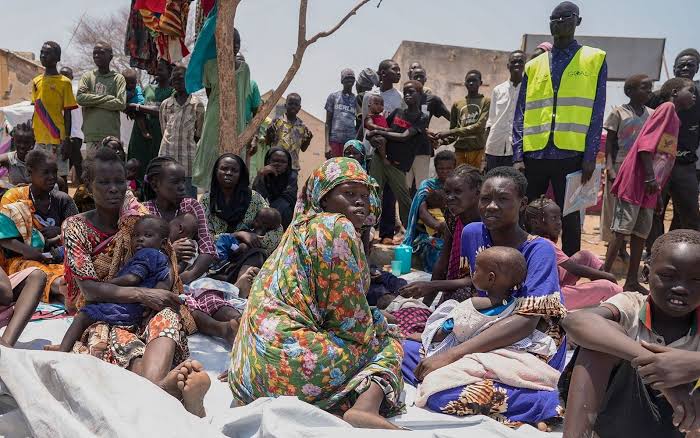
Sudan should not be treated as another distant conflict happening somewhere else. Sudan sits at the intersection of North Africa, the Horn of Africa, the Sahel and the Red Sea. Its instability affects neighbouring countries, refugee flows, food systems, trade routes and regional security.
But perhaps the most important lesson is simpler. Africa cannot afford to become accustomed to mass death on African soil. Sudanese civilians are not statistics. The over 13 million displaced are families. The millions facing hunger are not an abstract food-security graph. The women subjected to sexual violence are survivors. The children dying from malnutrition or disease are not collateral numbers in a geopolitical contest.
And the international community’s response matters because Sudan’s war is not inevitable. Diplomacy, humanitarian access, accountability and pressure on those supplying weapons can change the incentives sustaining the conflict. The UN Secretary-General has now called for countries fuelling the war through weapons and other support to be held accountable.
RELATED: