Wayne Lumbasi

President Yoweri Museveni’s announcement of his new cabinet for the 2026–2031 government term has reignited a fierce national debate over political patronage, nepotism, and the consolidation of state power within the first family, following his decision to retain First Lady Janet Kataaha Museveni as the Minister of Education and Sports.
The reappointment ensures the First Lady will cross a decade in control of one of Uganda’s largest, most heavily funded, and strategically significant ministerial budgets. Having first assumed the education portfolio in June 2016 following a five-year stint as Minister for Karamoja Affairs, her continuation in the role has drawn sharp rebukes from opposition figures and civil society groups who view the move as an overt display of dynastic politics.

To many political observers, the retention of the First Lady cannot be viewed in isolation. It follows a consistent pattern of elevating immediate family members to the highest echelons of Uganda’s political and military architecture. This includes the steady ascent of the president’s son, Gen. Muhoozi Kainerugaba, within the Uganda People’s Defence Forces (UPDF). The argument raised against these parallel paths within the executive and the military is that they are designed to secure a family-led political transition. Furthermore, because the Ministry of Education and Sports controls a massive share of the national budget and influences civic development nationwide, placing such a critical apparatus under the direct custody of the First Lady insulates the regime’s core leadership from external accountability.

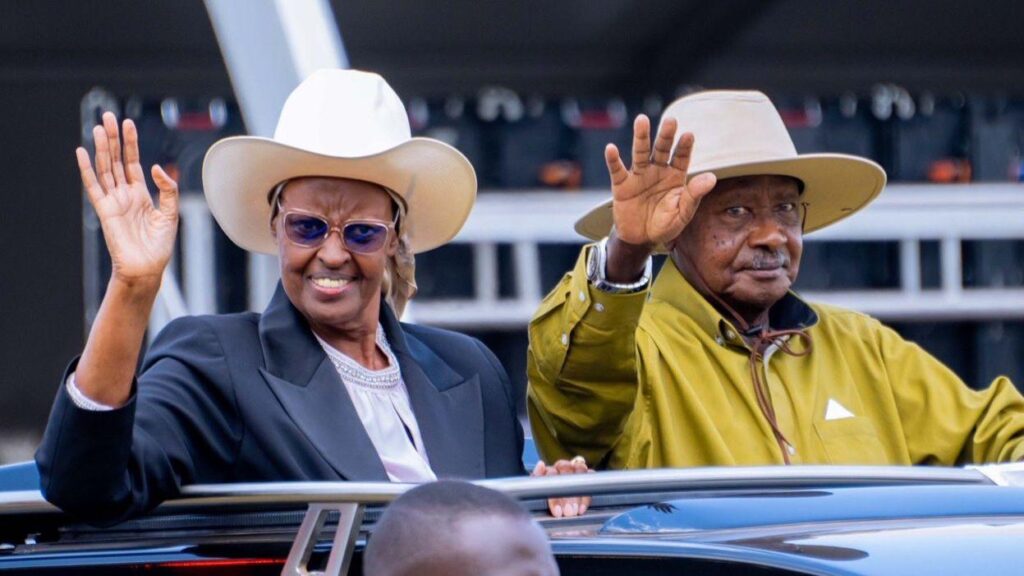
Opposition leaders and independent commentators instantly condemned the decision, framing it as a dismissal of democratic meritocracy in favor of familial loyalty. The core objection is that treating vital public offices as hereditary or marital entitlements deepens institutional stagnation and compromises the checks and balances necessary for democratic governance.

There are widespread points to the ongoing crisis of quality in the universal primary and secondary education sectors as evidence that the ministry requires fresh, independent leadership rather than political continuity. In public forums and digital spaces, the reappointment has been characterized as a reminder of the president’s famous assertion that he is “not a servant” of the public, but rather a leader answerable to his own vision for the state.
Conversely, the ruling National Resistance Movement (NRM) and presidential spokespersons have vigorously pushed back against accusations of nepotism. The official government position is that the First Lady’s reappointment is based strictly on merit, citing her long history in public service, her educational background, and her stewardship of the sector during major transitions including the recently completed Education Policy Review Report. The administration maintains that at a time when the country is undergoing critical educational reforms, institutional stability and proven loyalty to the NRM manifesto outweigh political optics.

As the cabinet list moves to the NRM-dominated Parliament for vetting, approval is widely expected to be a formality. However, the political fallout from the decision is likely to persist, further cementing the debate over nepotism as a defining feature of the country’s contemporary political scene.
RELATED: