Wayne Lumbasi

Pope Leo XIV issued a historic, unprecedented apology on Monday for the Vatican’s institutional complicity in the trans-Atlantic slave trade and its centuries-long delay in condemning the practice. The sweeping admission was published in the Pope’s highly anticipated first papal encyclical, titled Magnifica Humanitas (Magnificent Humanity). While previous pontiffs, including St. John Paul II and Pope Francis, have issued apologies for the sins of individual Christians who participated in colonial-era atrocities, Pope Leo XIV’s statement marks the first time a pope has explicitly acknowledged the structural, institutional responsibility of the Holy See itself.
In the text of the encyclical, Pope Leo did not shy away from the darkest chapters of Vatican history, specifically citing how 15th-century papal decrees such as those issued by Pope Nicholas V actively authorized European monarchs to conquer foreign lands and reduce non-Christian populations to “perpetual slavery.” These historical edicts formed the foundation of what legal and historical scholars call the “Doctrine of Discovery.”

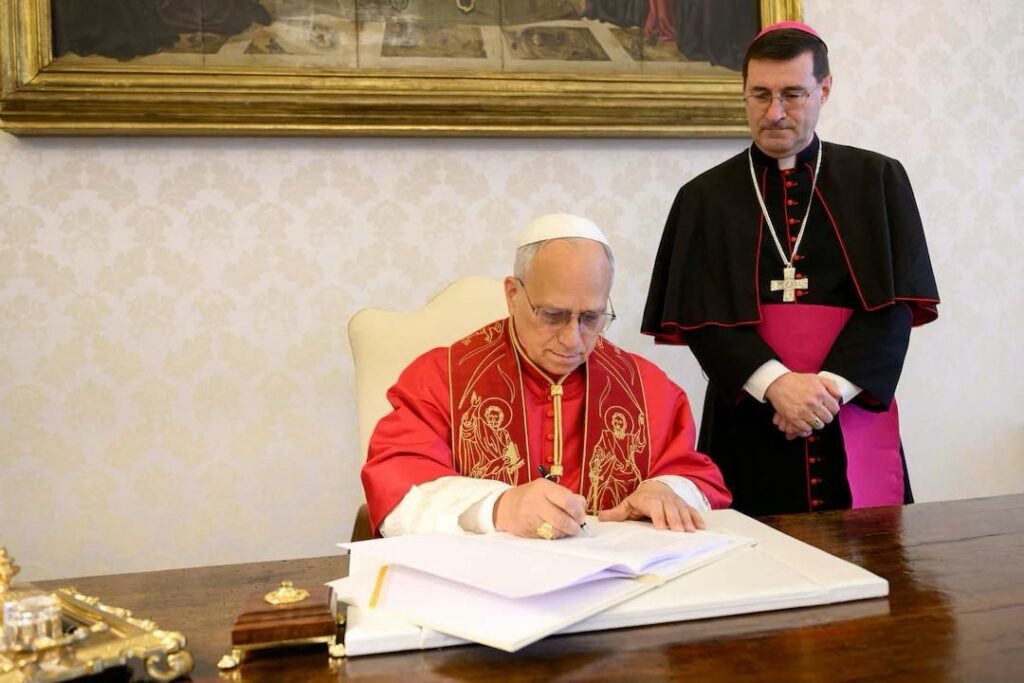
“Already in the early modern period, the Apostolic See of Rome, responding to the requests of sovereigns, intervened several times in order to regulate and legitimize forms of subjugation, and, in certain cases, including the enslavement of ‘infidels,'” the Pope wrote.

He further acknowledged that during the Middle Ages, ecclesiastical and church institutions directly owned enslaved people. Conceding that it took the Church 18 centuries to formally state that slavery was entirely incompatible with human dignity- a clarity not achieved until Pope Leo XIII’s universal condemnation in 1888 the Pontiff called the delay an undeniable moral failure.

“Yet neither can we deny or diminish the delay with which both society and the Church came to denounce the scourge of slavery,” Leo stated. “This constitutes a wound in Christian memory, one from which we cannot consider ourselves detached. For this, in the name of the Church, I sincerely ask for pardon.“
The apology is being hailed by historians and human rights advocates as a monumental shift. For decades, the Vatican resisted accepting direct, institutional accountability for colonial-era slavery, often framing past abuses as the fault of secular empires or flawed individual believers. The declaration also carries deep personal significance for the Pontiff. Pope Leo XIV, the first U.S.-born pope, possesses a well-documented American family genealogy that includes both enslaved individuals and slaveholders, making him uniquely positioned to confront the legacy of the trans-Atlantic trade.

Remarkably, the Pope’s historic apology was not delivered as a mere retrospective. Instead, the 42,300-word “MagnificaHumanitas” weaves this historical confession into an urgent, modern warning regarding the rapid rise of Artificial Intelligence (AI) and unregulated digital economies. Pope Leo drew a direct parallel between the Church’s past blindness to the horrors of colonial slavery and society’s current vulnerability to what he described as new forms of systemic, technological subjugation.
The encyclical heavily critiqued “opaque algorithms,” labor exploitation in tech supply chains (such as the hazardous mining of rare minerals for microchips), and the rise of “surveillance capitalism” controlled by corporate monopolies. The Pope strongly cautioned that massive, unchecked corporate automation risks causing a “social calamity” by sacrificing human livelihoods for profit.
By actively cleansing the Church’s historical slate regarding colonial slavery, the Vatican aims to secure the moral authority necessary to demand strict global regulations on emerging technology. The Church must firmly oppose the exploitation connected to the digital revolution, the Pope warned, “if we want to avoid the need to ask for pardon again in the future for having failed to respect the treasure of human dignity.“
RELATED: