Wayne Lumbasi

President Daniel Chapo has signed a new mining law that heavily restricts raw exports and guarantees government equity in all mining projects. The landmark legislation aims to position the southern African nation to capture a greater share of the economic value generated by the global rush for electric vehicle battery components and critical minerals.
The law, which cleared parliament last month, seeks to fundamentally shift how international investors access the country’s vast mineral wealth. According to an official government notice, the updated legal framework is specifically designed to strengthen the state’s sovereign management of strategic resources in defense of the national interest.

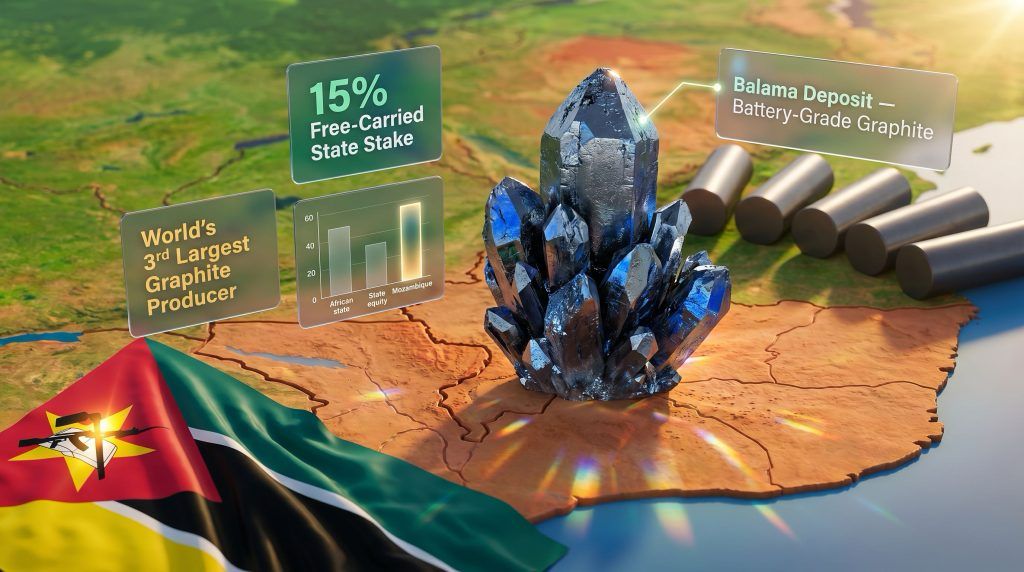
Under the core statutory provisions of the new law, the Mozambican government will command a minimum 15% free-carried and non-dilutable equity stake in all domestic mining operations. This interest will be managed across every stage of the development value chain by the state-owned mining enterprise, Empresa Nacional de Mineracao (ENM). Because the equity is designated as free-carried, the government is not required to make financial or capital contributions toward exploration and development costs, and its ownership share cannot be diminished by future capital calls or corporate structural changes.

Alongside the mandatory equity mandate, the legislation introduces a strict ban on the export of all raw or semi-processed mineral products. Global mining operators will be legally prohibited from shipping unprocessed resources out of the country unless they secure explicit ministerial authorization. To qualify for a waiver, companies must present verified, concrete plans detailing how they will eventually transition to operating domestic, onshore downstream processing facilities.

By enforcing these strict localized regulations, Mozambique joins a growing regional trend toward resource nationalism. Several resource-rich African nations have recently enacted similar measures to protect domestic economies from raw commodity extraction. The Democratic Republic of Congo, the world’s leading cobalt producer, and Zimbabwe, Africa’s top lithium producer, have both previously imposed severe restrictions on unrefined mineral exports to compel multinational corporations to fund local smelting and refining.
The timing of Maputo’s policy shift reflects the immense strategic leverage the country currently holds within global technology supply chains. Mozambique is the world’s third-largest producer of graphite, a mineral that is indispensable for manufacturing the anodes used in electric vehicle batteries and large-scale energy storage systems. The country hosts one of the largest graphite deposits on Earth at the flagship Balama operations in its northern territory. It is also home to the Montepuez deposit, the world’s largest known ruby mine, alongside substantial coal and heavy mineral sands assets.

As Western economies and Asian manufacturers seek to diversify their critical mineral supply chains away from Chinese processing monopolies, Mozambique’s world-class deposits have become highly contested. The new legislation effectively forces foreign investors to choose between investing in local industrialization or risking access to these vital resources.
The Chamber of Mines of Mozambique (CMM) noted that while the revision represents the most significant legislative shift in the sector since 2014, structural challenges persist. The country’s mining sector continues to grapple with severe logistical constraints, including high real interest rates, expensive electricity supply, and fragmented cross-border transport corridors. Building out advanced local refining capacities will require massive capital investments to overcome these infrastructural bottlenecks.
The government has not yet clarified whether the new ownership and export mandates will apply retroactively to existing operational mines. Because most major mining assets in the country currently operate under long-term, legally binding contractual frameworks, retroactive enforcement could trigger protracted contract renegotiations or international legal arbitration.
Despite these immediate uncertainties, some progress toward localized processing is already visible. A graphite concentration plant backed by a Chinese mining developer commenced commercial operations earlier this year, marking a minor milestone for domestic beneficiation. Market watchdogs suggest that the ultimate success of the new policy will depend on the government’s ability to lower energy costs, upgrade regional transport networks like the Maputo and Nacala logistics corridors, and maintain consistent regulatory enforcement.
RELATED: