Faith Nyasuguta

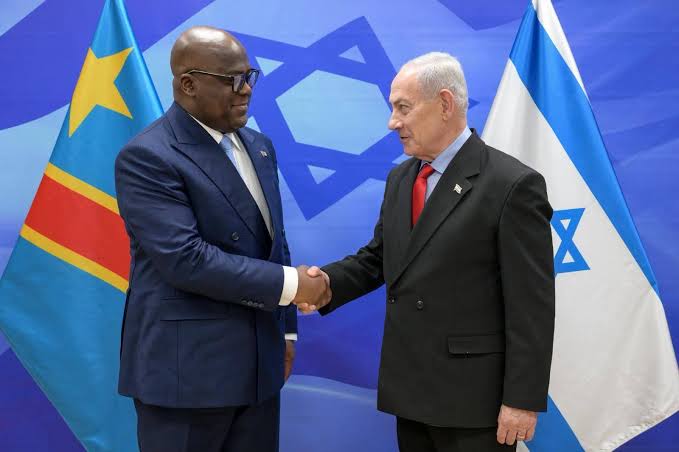
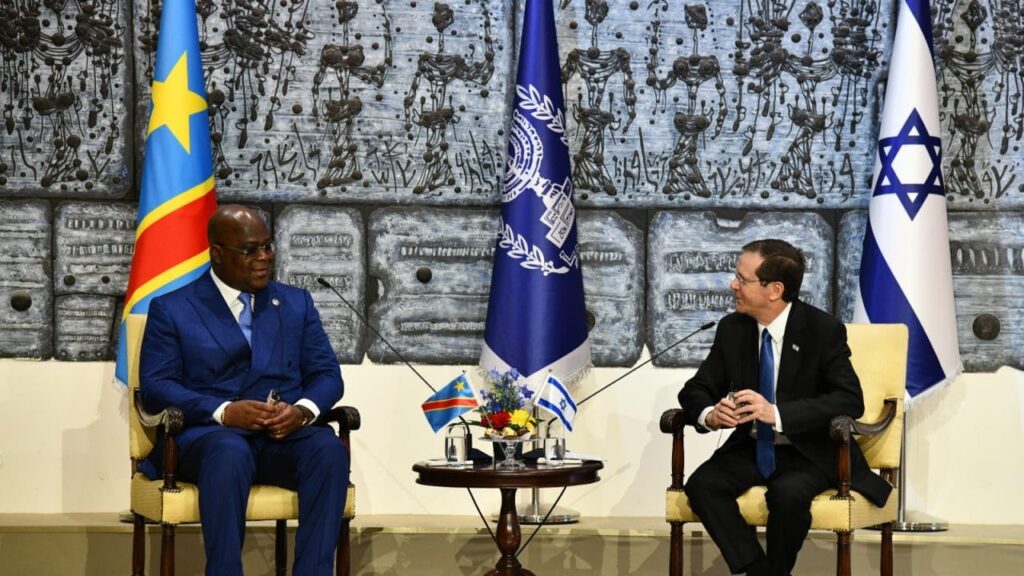
On September 1, 2026, Democratic Republic of Congo President Félix Tshisekedi sat down with Israeli Prime Minister Benjamin Netanyahu in Jerusalem as the two countries moved to deepen what they describe as a strategic partnership.
The public agenda was broad: security, defence, agriculture, infrastructure, energy and high technology. Netanyahu described the relationship as a “great friendship” that the two sides wanted to deepen, while Tshisekedi called for a modern, pragmatic and mutually beneficial partnership measured by implementation rather than diplomatic declarations.

But beneath the language of friendship lies a much bigger strategic calculation. The DRC is one of the world’s most important sources of minerals needed for batteries, electronics, defence systems and the energy transition. Israel, meanwhile, has highly developed capabilities in defence technology, surveillance, cybersecurity, agriculture and water management.

That creates a potentially powerful exchange: Congo needs technology and security; Israel wants deeper economic and strategic access to one of Africa’s most resource-rich countries.
There is, however, an important distinction. No public agreement from the Jerusalem meeting shows that Israel was promised Congolese minerals in exchange for weapons. The connection is better understood as a strategic convergence of interests that could produce defence, technology and investment deals over time.
Congo’s Security Problem
For Tshisekedi, security is not an abstract issue. Eastern Congo remains trapped in one of Africa’s longest-running conflicts, involving M23 and numerous other armed groups. The renewed M23 offensive that began in 2025 produced massive displacement across North and South Kivu. IOM recorded more than 1.15 million people displaced across the two provinces as a result of the M23 advance between January and March 2025, while UNHCR says the conflict continued into 2026 with no tangible improvement for many civilians.
The crisis has also become deeply regional. Kinshasa accuses Rwanda of supporting M23, an accusation Kigali has rejected. The United Nations and other international actors have repeatedly addressed the conflict and its regional dimensions.
For the Congolese government, therefore, better intelligence, surveillance, border monitoring and military capabilities could significantly change how it responds to armed groups operating across an enormous and difficult terrain.
That is where Israel becomes attractive. Israel has built an international reputation around unmanned systems, intelligence, surveillance, communications, cybersecurity and military technology. For Congo, these capabilities could potentially help monitor remote territory, secure strategic infrastructure and improve intelligence collection.
But any future arms arrangement would still have to be examined separately: what system is being supplied, to whom, under what conditions and with what safeguards? The Jerusalem meeting itself did not announce such a weapons package.
The Mineral Question
The DRC’s mineral importance is difficult to overstate. According to the U.S. Geological Survey, Congo was the world’s leading cobalt producer in 2024, accounting for approximately 75% of global cobalt production and 55% of estimated global reserves. It was also the world’s leading producer of tantalum, accounting for about 51% of global output. Congo was additionally the world’s second-largest producer of industrial diamonds and mined copper.
These are not ordinary commodities. Cobalt is important in lithium-ion battery supply chains. Tantalum is critical for electronic components. Copper is indispensable to electrical networks, construction, renewable-energy infrastructure and modern industry.
The strategic issue is not simply how much Congo possesses. It is who controls the extraction, processing, transport and financing of those resources.
Much of the world’s cobalt supply chain has historically been connected to Chinese refining and processing capacity. USGS notes that China was the world’s leading refiner of cobalt and that much of its refinery feedstock came from Congo. That has transformed Congolese minerals into a geopolitical issue.
Washington, Beijing, European governments and private companies are all interested in securing reliable critical-mineral supply chains. Israel is now seeking a stronger position within that competition.
Why The Lobito Corridor Matters
This is where the Lobito Corridor enters the picture. The corridor connects the mineral-producing regions of the DRC and Zambia to Angola’s Atlantic port of Lobito, creating an alternative route for exporting copper, cobalt and other commodities without relying on the traditional routes through eastern or southern African ports.
The United States and European Union have explicitly backed the corridor as a way of improving regional connectivity and securing critical-mineral supply chains. Their December 2025 declaration described the corridor as central to increasing investment, strengthening trade and connecting the DRC to global markets.
And Kinshasa itself has made the corridor part of its broader economic strategy. Ahead of Tshisekedi’s Jerusalem visit, the Congolese presidency said discussions would include opportunities for Israeli investment connected to the Lobito Corridor. It also said the visit would review memorandums signed in July 2026.
That detail matters. Israel does not necessarily need to own a mine to benefit from Congo’s mineral wealth. Strategic opportunities can exist in logistics, technology, processing, infrastructure, security and financing around the minerals. And that is potentially far more important than simply securing another mining concession.
Israel’s African Strategy
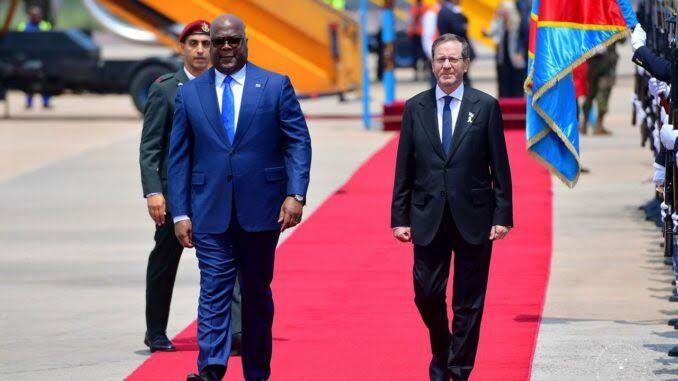
The Congo relationship also fits into Israel’s broader effort to deepen its relationships across Africa. Israel’s Foreign Ministry maintains an Africa Division responsible for relations with 47 sub-Saharan African countries, while operating 11 embassies on the continent.
The DRC is particularly significant because of its size, population, natural resources and diplomatic weight. Israeli President Isaac Herzog’s message during a separate September 1 meeting with Tshisekedi was unusually explicit: he said Israel places a major focus on relations with Africa and praised Congo’s support for Israel internationally.
So this partnership is not only about minerals. It is also about markets, diplomacy, technology and influence.
For Kinshasa, Israel offers another international partner at a time when Congo is deliberately diversifying its strategic relationships.
Congo is simultaneously engaging the United States, China, Europe and other powers over minerals, infrastructure and security. In February 2026, Tshisekedi met senior US officials in Washington to discuss critical minerals, local processing, strategic stockpiles and the Lobito Corridor.
That tells us something important: Congo is not simply choosing one foreign power. It is shopping for leverage.
Who Benefits?
Congo has enormous mineral wealth, but mineral wealth alone does not automatically create prosperity. The country needs roads, railways, electricity, processing facilities, technology, security and industrial capacity to turn raw resources into greater domestic value.
That is why the phrase “critical minerals” can be misleading if it focuses only on foreign demand. For Congo, the real strategic prize should be moving beyond the traditional model of extracting ore and exporting it.
If Israeli companies bring sophisticated technology, infrastructure and investment, the question should be whether Congo captures enough value through jobs, taxation, local processing, technology transfer and industrial development.
The same applies to security cooperation. Advanced surveillance and defence technology may strengthen the state, but technology alone cannot resolve a conflict whose roots include regional politics, armed-group financing, governance failures and competition over territory and resources.
RELATED: