Faith Nyasuguta

Kenya is paying an extraordinary price for corruption, questionable government contracts and weak accountability, with the World Bank estimating that governance failures are adding approximately KSh370 billion (US$2.8 billion) to the country’s annual fiscal deficit.
But behind the staggering figures lies an even bigger question: Where is the money going, who is benefiting, and why are Kenyan taxpayers struggling to see how billions of shillings are spent?

The World Bank’s 34th Kenya Economic Update, released on November 4, 2026, delivers one of the clearest assessments yet of the economic damage associated with corruption in Kenya. The report identifies corruption as a major obstacle to faster economic growth, placing Kenya among the weaker-performing lower-middle-income economies on governance indicators.

Its findings reveal a troubling picture of inflated infrastructure costs, limited procurement transparency, expensive electricity contracts, revenue leakages and businesses struggling under the weight of bribery. The financial consequences are substantial.

According to the World Bank, corruption and collusion affecting government expenditure and revenue collection widen Kenya’s annual fiscal deficit by approximately two percentage points of gross domestic product. That translates to roughly KSh370 billion annually, based on the economic estimates used in reporting on the findings.
The figure captures the wider financial consequences of governance failures, including revenue losses and inefficient public spending. And while the government continues searching for ways to increase revenue, the report raises an uncomfortable question. Why should Kenyans shoulder additional financial pressure when the country could potentially save billions by fixing how public money is managed?

KSh1.2 Trillion in Government Contracts, but Where Are the Details?
Public procurement is one of the biggest channels through which Kenya spends taxpayers’ money. Every year, government institutions award contracts for roads, hospitals, school supplies, electricity projects, technology systems, vehicles, equipment and other public services.
The World Bank estimates that public procurement accounts for at least 10% of Kenya’s economic output. Its conservative expenditure calculation uses approximately KSh1.2 trillion annually. Yet the information available to the public tells a troubling story.
During the 2024/25 financial year, procurement transactions worth approximately KSh410 billion had at least some information published through Kenya’s Public Procurement Information Portal. More detailed information identifying winning bidders and contract amounts was available for only KSh186 billion.
Using the World Bank’s KSh1.2 trillion procurement benchmark, that means publicly available records containing detailed contract information covered an amount equivalent to just 15.5% of estimated annual procurement expenditure.
The remaining gap raises serious questions about transparency.
Who received the contracts?
Which companies won the tenders?
How were their prices determined?
Who owns those companies?
And how much did taxpayers ultimately pay?
These are not minor administrative details. They are fundamental questions about the management of public money.
When contract information is difficult to obtain, examining whether projects were competitively awarded becomes considerably harder. The same applies to identifying conflicts of interest, inflated prices, unexplained contract variations and payments for incomplete work.
For a country spending more than a trillion shillings annually through procurement, the lack of comprehensive disclosure represents a significant accountability problem. If taxpayers finance government contracts, why should the identities of contractors, the amounts awarded and the results delivered be difficult to establish?
Kenya’s Standard Gauge Railway: The KSh117 Billion Question
Perhaps one of the most striking examples in the World Bank’s assessment concerns Kenya’s Standard Gauge Railway. The railway connecting Mombasa and Nairobi was presented as a transformative infrastructure investment intended to improve freight transportation, strengthen regional trade and modernise the country’s transport network.
But its construction costs have become a major point of scrutiny. According to the World Bank’s analysis, Kenya’s 472-kilometre Mombasa–Nairobi railway cost approximately KSh987 million per kilometre. Compare that with neighbouring Tanzania. Its electrified Dar es Salaam–Dodoma railway cost approximately KSh740 million per kilometre. Ethiopia’s electrified Addis Ababa–Djibouti railway cost approximately KSh688 million per kilometre.
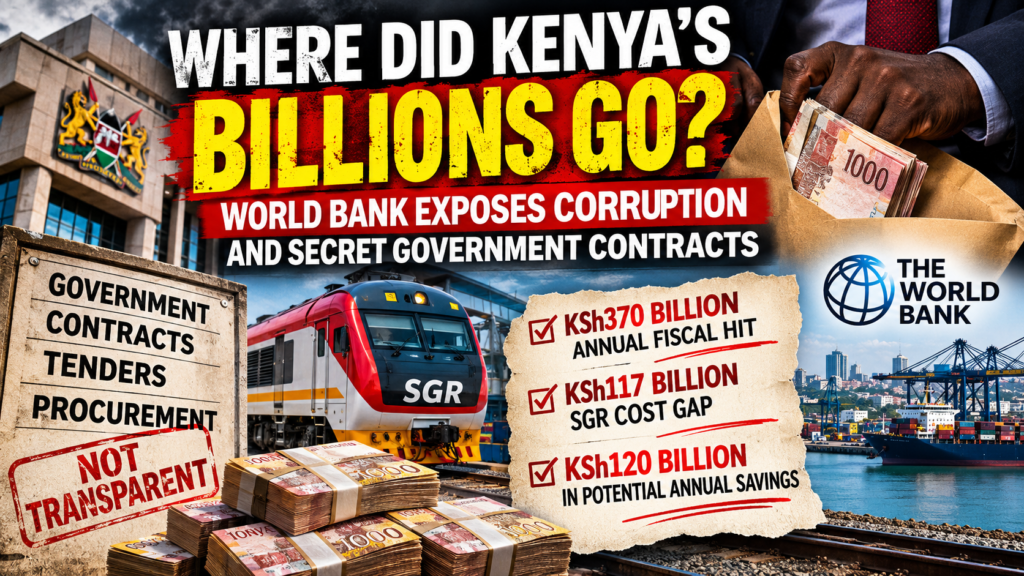
Kenya’s diesel-powered railway was therefore substantially more expensive per kilometre than these electrified regional projects. The World Bank estimates that Kenya could potentially have saved approximately US$900 million, equivalent to KSh117 billion, if the initial construction costs had matched Tanzania’s benchmark. That is an extraordinary difference.
The report identifies governance-related factors behind part of the cost gap, including direct contracting instead of competitive tendering, land speculation and reported irregularities involving land titles, valuations and compensation. At least 30% of the estimated difference is attributed to governance-related factors. That represents approximately US$270 million.
These findings place the procurement and management of the railway under renewed scrutiny.
Why was Kenya’s project so expensive?
How were construction prices negotiated?
Could stronger competition have produced a better deal?
And which institutions were responsible for ensuring taxpayers received value for money?
The SGR continues to serve an important transport function, but its economic benefits do not eliminate the need to examine its construction costs. Kenya built a railway. The World Bank’s findings now raise questions about whether taxpayers paid substantially more than necessary to get it.
The KSh120 Billion Kenya Could Save Every Year
The World Bank’s assessment goes beyond identifying expensive projects. It also estimates how much Kenya could save through better procurement management. According to the institution, reducing procurement-related expenditure leakage and inefficiencies by just 10% could generate annual savings of approximately KSh120 billion (US$930 million). That is nearly one billion dollars every year.
The calculation uses a conservative procurement expenditure base of KSh1.2 trillion. The potential savings raise an important question about Kenya’s fiscal priorities.
What could KSh120 billion finance?
More healthcare facilities?
Additional classrooms and school infrastructure?
Better roads and water systems?
Or lower borrowing requirements?
These are competing policy choices, but the financial opportunity is substantial. The findings suggest that improving procurement efficiency could free up resources without requiring an equivalent increase in tax collections. This matters in a country where debates about taxation have triggered widespread public anger.
During the 2024 protests against proposed tax increases, corruption and government spending became central concerns among demonstrators. The World Bank’s latest findings give renewed economic weight to those concerns. If Kenya could save KSh120 billion annually through better procurement, why is raising additional revenue so often more visible than eliminating wasteful expenditure?
Public Debt Is Rising While Corruption Adds to the Pressure
Kenya’s procurement problems are unfolding against a difficult financial backdrop. According to the World Bank, the country’s fiscal deficit reached 6.8% of GDP in the previous financial year, exceeding the government’s target of 4.7%. Public debt stood at approximately 72.3% of GDP in August 2026.
Meanwhile, interest payments were consuming roughly one-third of government revenue. That means a substantial portion of the money collected by the government is already committed to servicing existing debt.
The World Bank warns that corruption and collusion increase borrowing requirements, adding to financial obligations that accumulate over time. The consequences extend beyond government accounting.
When public spending becomes more expensive than necessary, the Treasury faces greater pressure to find additional financing. Higher borrowing can increase future interest payments.And larger debt-service obligations reduce the resources available for essential public services.
The report also identifies a governance-related premium affecting Kenya’s borrowing costs. Concerns about institutional quality, fiscal management and corruption can influence how lenders assess sovereign risk. The result is a costly cycle.
Inefficient expenditure increases financing needs.
Additional borrowing increases debt obligations.
And servicing those obligations places greater pressure on future budgets.
For taxpayers, the concern is straightforward.
Kenyans are paying to finance government expenditure today while also carrying the cost of borrowing used to finance expenditure from previous years.
That makes transparency over major public contracts even more important.
Kenya’s Electricity Contracts Raise More Questions
The World Bank also identifies governance weaknesses affecting the electricity sector. According to its analysis, electricity costs for Kenyan businesses are nearly 50% higher than in neighbouring Uganda and more than twice those in Vietnam.
The report links high costs in essential economic sectors to governance challenges, including nontransparent contractual arrangements. A particularly concerning finding relates to power purchase agreements. Of 42 agreements examined in a study cited by the World Bank, only approximately 24% were known to have undergone competitive procurement.
That raises questions about how electricity supply contracts were negotiated and whether greater competition could have produced lower prices. The consequences are felt across the economy.
Expensive electricity increases operating costs for manufacturers.
It raises expenses for businesses.
It can weaken Kenya’s competitiveness against countries offering cheaper energy.
And some of those costs eventually reach consumers through the prices of goods and services.
The World Bank’s analysis therefore connects procurement transparency with everyday economic pressures. The issue is bigger than the price of electricity. It concerns the processes through which long-term public obligations are negotiated. Who negotiates Kenya’s major electricity contracts, how are prices determined, and how much could consumers save through more competitive procurement?
Corruption Is Hurting Kenyan Businesses
The World Bank’s findings also reveal how corruption affects private enterprise. According to the report, 39% of Kenyan firms identify corruption as a major constraint to their operations. That represents a significant increase from the 25% recorded in 2013. Among medium-sized businesses, approximately 48% report that giving gifts is necessary to get certain things done.
These figures point to a business environment where unofficial payments and administrative obstacles can impose additional costs on legitimate enterprises. A company competing on price and quality may find itself disadvantaged when access to services or approvals depends on informal payments. For small businesses, these costs can be particularly damaging. Many already face expensive credit, taxation, regulatory requirements and high operating expenses. Bribery adds another financial burden.
The World Bank also highlights the experiences of informal workers, including traders and transport operators who face repeated inspections, threats and demands for unofficial payments.
The impact extends to employment. Approximately 83.8% of Kenya’s jobs remain informal, often offering lower earnings and weaker employment protections. Corruption can discourage investment, reduce business profitability and undermine opportunities to create better-paying jobs. The cost of corruption is therefore not confined to government budgets. It also reaches businesses, workers and households.
Kenya’s Ports and Transport Corridors Are Also Paying the Price
Kenya’s transport infrastructure is another area highlighted in the report. The World Bank identifies governance and administrative weaknesses affecting logistics, including multiple inspections, weighbridge stops and police checks. Such obstacles can increase transport costs, create opportunities for bribery and delay the movement of goods.
The report also highlights the Port of Mombasa’s performance. In the World Bank’s Container Port Performance Index cited in the assessment, Mombasa ranked 375th out of 403 ports.
The ranking raises questions about operational efficiency in one of East Africa’s most important maritime gateways. Mombasa serves not only Kenya but also regional markets that depend on the Northern Corridor for international trade.
Delays and inefficiencies can therefore affect businesses far beyond the port itself. For importers, exporters and transport companies, additional costs can weaken competitiveness. For consumers, expensive logistics can contribute to higher prices.
The economic consequences demonstrate why improving governance in transport and trade is essential to Kenya’s regional ambitions. A country seeking to become East Africa’s leading logistics hub cannot afford persistent inefficiencies that make moving goods unnecessarily expensive.
Other African Countries Are Facing Similar Corruption Challenges
Kenya’s experience reflects a wider governance challenge across Africa. The World Bank’s Enterprise Surveys provide evidence of businesses encountering demands for unofficial payments in multiple African economies.
In Kenya, the 2025 survey recorded bribery exposure among a substantial share of businesses. Comparable surveys have also documented significant bribery-related pressures in Zimbabwe, Equatorial Guinea, the Democratic Republic of Congo, Nigeria, Mozambique and Uganda. These findings demonstrate that corruption-related costs are not confined to one region of the continent.
Public opinion research reveals similarly widespread concerns. Afrobarometer’s research across 39 African countries found that approximately 58% of respondents believed corruption had increased during the preceding year.
Country-level surveys have also reported substantial concern about corruption in Nigeria, Uganda, Ghana and South Africa. The economic implications are considerable. When businesses face unofficial payments, administrative uncertainty and unequal access to government services, investment becomes more difficult.
When public procurement lacks transparency, taxpayers struggle to assess whether major projects deliver value. And when oversight institutions cannot effectively scrutinise public expenditure, governance weaknesses can persist.
Some African countries are pursuing reforms.
Tanzania, for example, has introduced its National e-Procurement System, known as NeST, to digitise government purchasing and improve procurement administration.
The World Bank has highlighted improvements in processing efficiency associated with Tanzania’s digital procurement reforms.
The experience offers a relevant lesson for Kenya.
Technology can improve transparency, but its effectiveness depends on whether procurement information is accessible, contracts are competitively awarded and irregularities are investigated.
Across Africa, the challenge is not merely finding money for development. It is ensuring that available resources are managed transparently and efficiently.
Kenya’s Government Promises Reform
The Kenyan government says it is implementing measures to address governance weaknesses.
National Treasury Principal Secretary Chris Kiptoo has highlighted electronic procurement, more predictable payment timelines for contractors and legislation addressing conflicts of interest.
The government argues that these reforms will strengthen accountability and improve the management of public resources.
Electronic procurement could help create more consistent records of government purchasing and make tendering processes easier to monitor.
Clearer conflict-of-interest rules could strengthen safeguards against officials participating in decisions involving private interests.
More predictable payments could also reduce financial pressure on legitimate suppliers and contractors.
But the World Bank’s findings raise questions about the effectiveness of implementation.
A digital procurement platform is only as transparent as the information it makes available.
Publishing tender notices is one step.
Disclosing contract winners, ownership structures, agreed prices, variations and final payments is another.
For taxpayers, the difference is significant.
A government can announce a project and publish its estimated cost.
But without accessible information about procurement decisions and implementation, determining whether the public received value for money remains difficult.
The World Bank has called for greater fiscal discipline, stronger procurement transparency, beneficial ownership disclosure and improvements in tax and customs administration.
These reforms would strengthen the ability of oversight institutions to examine public contracts and identify potential conflicts of interest.
The government has acknowledged the importance of governance reform.
The question now is whether those commitments will produce measurable improvements in how public money is spent.
Kenya Could Be Far Wealthier With Stronger Governance
Despite its concerns, the World Bank recognises Kenya’s considerable economic potential.
The country’s economy grew by 5.2% during the first half of 2026, supported by stronger activity in industry and services.
The institution raised its full-year growth forecast to 4.6%, compared with its earlier projection of 4.3%.
However, it warns that governance weaknesses are preventing Kenya from achieving stronger and more inclusive growth.
Its economic modelling suggests that ambitious governance reforms could raise GDP by approximately 20% by 2035 compared with a baseline scenario.
The report also estimates that such reforms could support up to 7.7 million additional and better-quality jobs.
The implications are substantial.
Improved governance could strengthen investor confidence, reduce unnecessary business costs and allow public expenditure to support more productive activities.
Better procurement could lower the cost of infrastructure.
More efficient public administration could reduce barriers facing businesses.
And stronger accountability could help ensure that government resources deliver measurable benefits.
Kenya already possesses important economic advantages.
It has an established private sector, a growing digital economy, a young workforce and a strategic position in regional trade.
But the World Bank’s findings suggest that governance weaknesses are limiting how effectively those advantages translate into prosperity. Kenya’s economic potential is considerable. The cost of failing to address corruption is equally significant.
Where Did Kenya’s Billions Go?
The World Bank’s November 2026 report leaves Kenya facing questions that cannot be answered through economic forecasts alone. Why are detailed records available for such a limited portion of estimated government procurement?
Why did the Standard Gauge Railway cost substantially more per kilometre than comparable regional projects? Why have major electricity agreements not consistently undergone competitive procurement? And how much public money could be saved if contracts were more transparent and government institutions more accountable?
These questions concern the financial decisions that determine how public resources are allocated. They also concern the institutions responsible for approving contracts, monitoring expenditure and ensuring that projects deliver what taxpayers have financed.
Kenya’s public debt remains substantial. Interest payments continue consuming a significant share of government revenue. Businesses report persistent corruption-related obstacles. And millions of workers remain in informal employment.
Yet the World Bank estimates that addressing governance weaknesses could substantially improve public finances and long-term economic growth. The findings suggest that Kenya’s development challenge is not simply a shortage of money. It is also about how effectively available resources are managed. The country needs infrastructure, public services, investment and employment opportunities.
But achieving those objectives requires confidence that government contracts are competitively priced, properly implemented and open to scrutiny.
Kenyans have a legitimate interest in knowing who receives public contracts, how much they are paid, who ultimately owns the companies involved and what the country receives in return. Those answers should not depend on speculation. They should be available through transparent procurement records, credible audits and effective public oversight.
The World Bank has now placed a substantial financial estimate on the consequences of weak governance. Approximately KSh370 billion in annual fiscal pressure. KSh120 billion in potential procurement savings. And an estimated KSh117 billion difference between Kenya’s railway construction costs and a comparable regional benchmark.
Behind those figures are decisions about public money that deserve examination. Kenya is being asked to raise more revenue, manage its debt and finance its development ambitions. But before taxpayers are asked to carry additional burdens, one question deserves a clear answer:
WHERE IS THE MONEY GOING, WHO IS BENEFITING FROM GOVERNMENT CONTRACTS, AND WHY CAN’T KENYANS SEE THE FULL DETAILS OF HOW THEIR BILLIONS ARE SPENT?
RELATED: