Wayne Lumbasi

Kenyan government officials are facing scrutiny over allegations that they colluded with recruitment agencies and Russian officials to facilitate the recruitment of more than 1,000 Kenyan men into the Russian military to fight in the war against Ukraine.
The allegations are contained in the United States Department of State’s 2026 Trafficking in Persons Report, which raises concerns about possible collusion between public officials and private recruitment agencies, as well as the government’s response to agencies suspected of involvement in trafficking-related activities.

The report has renewed questions about how recruitment networks allegedly operated in Kenya, including whether individuals within government institutions helped recruits travel abroad under the promise of legitimate employment before being drawn into military service. However, the report does not publicly identify all the officials allegedly involved, and the allegations do not establish criminal responsibility against any particular individual.

The concerns come months after a disclosure in Parliament on February 18, 2026, when Majority Leader Kimani Ichung’wa presented information attributed to the National Intelligence Service and the Directorate of Criminal Investigations detailing how the recruitment networks allegedly operated.

According to the parliamentary account, personnel from the Directorate of Immigration Services, the DCI, the Anti-Narcotics Unit and the National Employment Authority were suspected of colluding with recruiters to facilitate the movement of Kenyan recruits through Jomo Kenyatta International Airport. The statement also raised allegations involving personnel at the Russian Embassy in Nairobi and the Kenyan Embassy in Moscow over visa arrangements.
The parliamentary statement did not name the individual officers allegedly involved, leaving the relevant institutions under pressure to establish who may have assisted the recruitment networks and whether disciplinary or criminal action would follow.

Investigators told Parliament that recruiters allegedly targeted Kenyans seeking work abroad with promises of lucrative salaries, substantial bonuses and opportunities to obtain Russian citizenship. Some were reportedly offered civilian jobs in security and construction, only to discover that they would be required to serve in the Russian military.
The recruitment offers were said to include monthly salaries of approximately KSh350,000, alongside signing bonuses ranging from KSh900,000 to KSh1.2 million. Some recruits reportedly travelled through Istanbul in Turkey and Abu Dhabi in the United Arab Emirates before reaching Russia. As scrutiny at Nairobi’s main airport increased, the networks allegedly began using alternative routes through Uganda, the Democratic Republic of Congo and South Africa.
The investigation has also brought private recruitment agencies under scrutiny. Global Face Human Resources Limited was identified in the parliamentary account as part of the network under investigation. The statement described the agency as unaccredited by Kenya’s National Employment Authority. Talent Shepherd Agency was also named as an agency allegedly conducting similar recruitment without the required registration.
The DCI account further identified Edward Kamau Gituku and Joel Muchiri Ngugi, also known as Caleb, in connection with a location at Great Wall Gardens in Athi River, where 22 potential recruits were reportedly found in September 2025. Russian national Mikhail Lyapin, also known as Sargevich, was linked to the recruitment activities and was reportedly arrested before being repatriated to Russia. The details presented to Parliament describe allegations and investigative actions, not proof that every person named has been convicted of an offence.
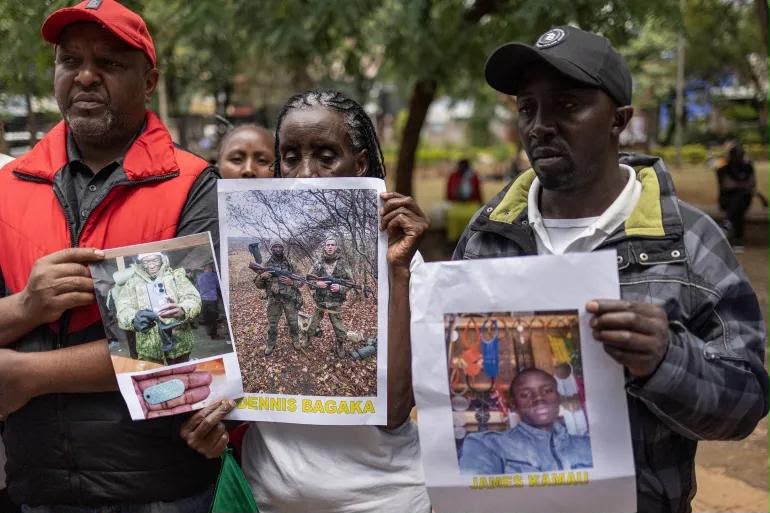
Behind the investigation are families struggling to establish the whereabouts of relatives who travelled to Russia believing they had secured legitimate employment. Some Kenyans have reportedly returned home injured, while others remain missing or are feared to have been deployed to the battlefield after limited military training. Their cases have intensified calls for the government to establish the true number of citizens affected, identify those still in danger and pursue the networks responsible.
The scale of the crisis remains uncertain, with different government and family records producing conflicting figures. On October 8, 2026, Prime Cabinet Secretary and Foreign Affairs Cabinet Secretary Musalia Mudavadi told a parliamentary committee that government records showed 354 Kenyans connected to the conflict, including 62 who had been repatriated. Families separately presented a list of 841 names requiring verification, while the US report referred to more than 1,000 Kenyan men allegedly recruited into the Russian military. The figures reflect different records and should not be treated as directly comparable counts of confirmed cases.
The latest US findings have consequently intensified scrutiny of Kenya’s oversight of overseas recruitment and its response to suspected trafficking. If public officials helped recruiters bypass immigration controls, secure travel arrangements or facilitate the movement of unsuspecting job seekers, investigators will need to establish who was involved, what actions they took and whether there is sufficient evidence to prosecute them.
For now, the public record identifies several private-sector suspects and sets out allegations involving multiple Kenyan and Russian institutions, but does not provide a verified list of individual Kenyan government officers proven to have facilitated the recruitment. Establishing the extent of any official involvement remains central to the investigation, as families continue to seek answers about relatives who left Kenya in search of work and instead found themselves caught up in a foreign war.
RELATED: