Faith Nyasuguta

Russia and the Central African Republic have signed a new plan to deepen cooperation in geology and mining, opening a fresh phase in Bangui’s efforts to better map its mineral resources and prepare them for investment.
The plan, approved during the first meeting of the Russian-Central African intergovernmental commission in Bangui, contains more than 30 measures covering geological exploration, technology, regulation, training and the development of future mining projects. Russia’s Ministry of Natural Resources said the programme will focus on gold and diamonds, which already form the backbone of CAR’s mining sector, while expanding exploration for uranium and oil.

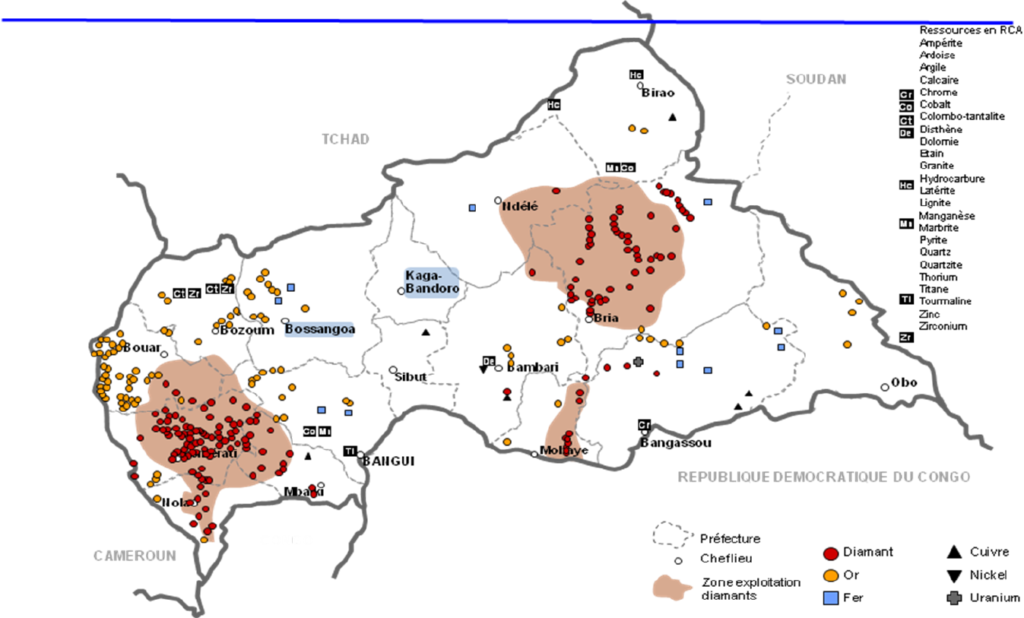
The agreement is significant because CAR’s mining industry remains relatively small compared with the country’s geological potential. The US Geological Survey says gold and diamond production contributed about 1.7% of CAR’s GDP in 2024, while the two commodities accounted for 36.3% of the country’s goods exports by value. Much of the production is artisanal rather than based on large-scale industrial mining.

CAR Wants To Know What Is Under Its Soil

At the heart of the agreement is geological knowledge. CAR cannot develop resources it has not properly identified, measured and assessed. The Russian-CAR plan therefore seeks to expand geological surveys across the country, improve the quality of geological information and prepare new areas for licensing.
The work will move beyond the country’s established gold and diamond areas to include what Russia describes as critical resources, as well as uranium and oil. The objective is to create a clearer geological picture that can eventually help governments and companies decide where exploration and mining investment makes economic sense.

This is an important distinction. Exploration is not the same as a commercial discovery. The agreement does not mean CAR has suddenly confirmed commercially viable uranium or oil reserves. It creates a framework for finding, assessing and potentially developing such resources.
That process can take years. Geological surveys must be followed by drilling, laboratory analysis, resource estimation, feasibility studies, environmental assessments, licensing, infrastructure development and financing before a deposit becomes a producing mine.
The Bigger Plan
One of the most notable elements is that Russia and CAR are not limiting the agreement to extraction. The programme is divided into three broad areas: building what Russia calls new sovereign capabilities, developing the country’s geological profile and creating a foundation for investment projects. The first includes regulatory improvements, modern technology, industry standards and professional training.
The two countries also intend to examine wider use of Russian geological exploration technologies and equipment in CAR.
A new comprehensive geological laboratory is planned, alongside a mining school. These institutions could become important if CAR wants to build a domestic workforce capable of conducting geological analysis, surveying, exploration and mine development rather than relying heavily on foreign technical expertise.
That makes the agreement potentially more consequential than a conventional mining concession.
A mining concession gives a company access to a deposit. A geological system gives a country the capacity to understand its entire mineral territory.
The Agreement Builds On A 2025 Memorandum
The latest plan is not starting from zero. In January 2025, Russia’s Ministry of Natural Resources and CAR’s Ministry of Mines and Geology signed a memorandum covering regional geological surveys, technological studies, mineral-resource development, reserve assessment, exploration and laboratory research.
The two sides subsequently established a working structure to turn that memorandum into practical cooperation. In April 2026, a Russian-CAR working group met in Bangui to advance cooperation in geological exploration and subsoil use.
The Russian Embassy in CAR said at the time that 519 mineral occurrences had been identified across the country, while gold and diamonds remained the foundation of the existing mining sector. The October plan therefore represents a move from broad cooperation toward a more detailed programme of action.
Why Russia Is Interested
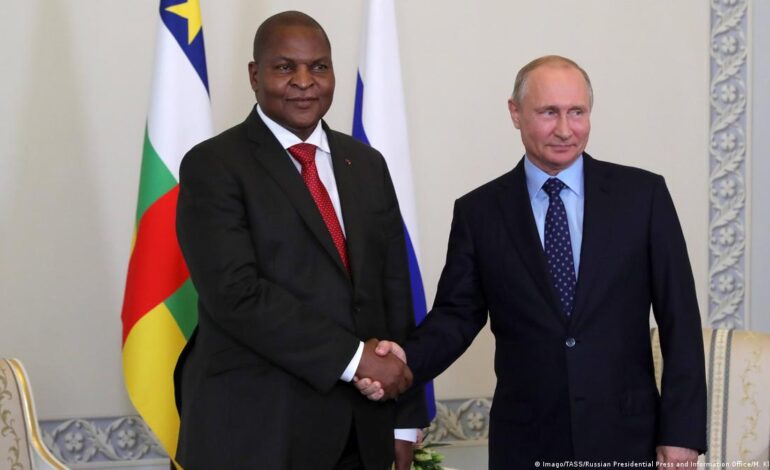
The agreement also fits into a much wider expansion of Russia-CAR relations. Russia has become one of President Faustin-Archange Touadéra’s most important international partners since Bangui turned away from its traditional relationship with France and sought closer security ties with Moscow.
Russian personnel have been present in CAR since 2018, initially through the Wagner Group. Russia has subsequently sought to transition its African security operations toward the state-controlled Africa Corps. Reports have also documented Russian-linked commercial interests in CAR’s mining sector, including gold and diamonds.
That history gives the new geological agreement an additional layer.
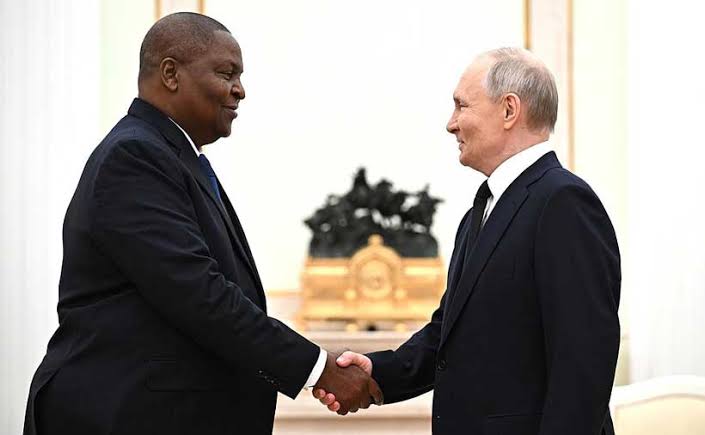
Russia is not entering CAR’s resource sector from the outside. It already has political, security and commercial relationships in the country. The new agreement could deepen those ties by placing Russian technology, equipment and expertise inside the geological infrastructure that determines how future mineral opportunities are identified and developed.
At the same time, the agreement should not automatically be interpreted as a Russian takeover of CAR’s mineral resources. The publicly announced plan is centred on cooperation, exploration, technical capacity and investment preparation rather than announcing ownership of specific new deposits.
Value Addition
For CAR, the central question will ultimately be what happens after exploration. Gold and diamonds already generate export earnings, but the country has limited industrial processing capacity. That means much of the economic value associated with minerals can be captured outside the country through processing, trading, financing and manufacturing.
This is a familiar African problem. A geological survey can tell CAR what resources it has. A mining project can extract them. But neither automatically creates broad industrialisation.
The bigger opportunity would be to connect mining with local employment, geological training, mineral processing, equipment supply, infrastructure and domestic businesses. The planned mining school and geological laboratory could therefore become as important as the exploration itself if they help CAR build permanent technical capacity.
CAR’S Investment Picture
The immediate outcome of the Russia-CAR agreement will not be a new mine or an overnight transformation of the economy. Its importance lies in what comes before mining: knowing where the resources are, understanding their quality and creating the technical and regulatory systems needed to develop them.
The first Russian-CAR intergovernmental commission also produced a broader cooperation protocol and an energy roadmap covering 2026–2028, showing that geology is becoming part of a wider economic relationship between Bangui and Moscow.
For CAR, the opportunity is to use foreign expertise to build institutions that remain useful to the country long after individual projects end. For Russia, the agreement expands its role from security and diplomacy into the technical infrastructure surrounding Africa’s mineral economy.
And for Africa, the lesson is straightforward: resource sovereignty begins before extraction. It starts with knowing what lies beneath the ground, owning the data, training the people who interpret it and using that knowledge to negotiate investment from a position of greater strength.
RELATED: