Faith Nyasuguta

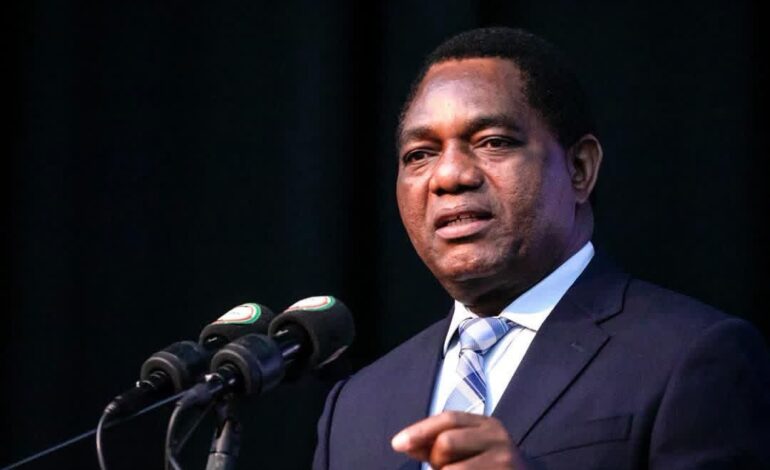
Zambia is facing a serious test of its democracy after authorities closed the country’s top courts on August 24, the final day for the opposition to challenge President Hakainde Hichilema’s disputed re-election.
The closure included the Constitutional Court, the institution expected to hear a presidential election petition. Court staff were instructed not to report for work, while security forces were deployed around judicial premises. Authorities cited security concerns.

The timing, however, is what has triggered the alarm. Hichilema was declared the winner of the August 13 election with about 60% of the vote, while opposition leader Brian Mundubile received roughly 38%. Mundubile had announced plans to challenge the result, citing alleged irregularities. The European Union’s election observers also raised concerns over transparency and procedural problems during the vote-counting process.

The opposition has therefore been left trying to exercise a constitutional right at precisely the moment access to the courts was restricted.

That does not, by itself, prove that Hichilema ordered the courts closed to prevent a petition. His administration has denied responsibility, with the State House saying the president did not order the closure and maintains that the judiciary is an independent arm of government.
But the episode raises a bigger democratic question: what happens when the institution designed to resolve an election dispute becomes inaccessible on the very day a challenge must be filed?

Election petitions are not simply political complaints. They are a legal mechanism through which losing candidates can ask courts to examine whether an election complied with the constitution and electoral law. And Africa has already shown why that mechanism matters.
In Kenya in 2017, opposition leader Raila Odinga challenged Uhuru Kenyatta’s election. The Supreme Court found that the election had not been conducted in accordance with the constitution and electoral law and nullified the result, ordering a fresh presidential election. It became a landmark example of an African court exercising judicial power over an election outcome.
Uganda offers a different lesson. In 2021, opposition leader Bobi Wine challenged President Yoweri Museveni’s victory but later withdrew the petition, accusing the court of bias and arguing that security restrictions had obstructed his ability to present evidence.
And that brings Zambia’s current crisis into sharper focus. There is an especially uncomfortable historical irony for Hichilema himself.
Before becoming president, he was the opposition leader being pursued by the state. In April 2017, Hichilema was arrested and charged with treason after authorities accused his convoy of obstructing then-President Edgar Lungu’s motorcade. Amnesty International described the charges as politically motivated and documented concerns over his detention conditions.
Today, Hichilema occupies the other side of that political equation. His government says it is protecting national security. The opposition says it is being prevented from challenging power through lawful means. Human-rights officials and legal groups have warned that the court closure risks undermining the constitutional right to challenge election results. That distinction matters.

A functioning democracy is not tested only when the ruling party wins a popular vote. It is tested after the vote, when the loser asks: Can I challenge this result, and will the institutions hear me?
Zambia has long been regarded as one of Africa’s more stable multiparty democracies. Its current post-election tensions therefore matter beyond Lusaka.
The real danger is not merely who won the election. It is whether the institutions remain open enough for the country to prove that the result can withstand scrutiny.
RELATED: