Wayne Lumbasi

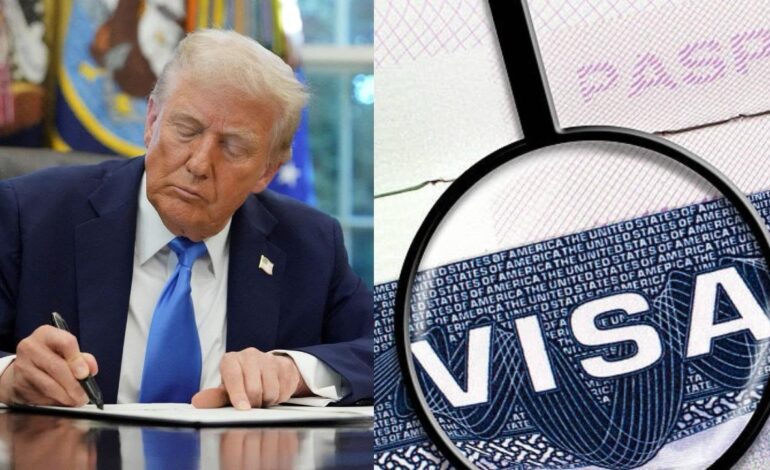
The State Department is coordinating with the Department of Homeland Security to carry out what could become the largest single mass visa revocation in United States history. The planned action targets the business and tourism visas of up to 200,000 foreign nationals who subsequently applied for or are actively seeking asylum. The measure specifically focuses on non-immigrant B1 and B2 visas issued between 2016 and 2026, marking a significant expansion of executive efforts to curb legal pathways that officials argue are being systematically exploited.
Administration officials frame the policy as a necessary step to close a perceived loophole in the nonimmigrant visa framework. Officials argue that temporary visitor programs are being misused as a backdoor for permanent residency, emphasizing that a visitor visa is a privilege rather than an entitlement. State Department representatives have noted that cross-referencing visa records with active asylum filings allows the government to systematically identify individuals who entered the country under short-term pretexts but later filed claims to remain indefinitely.

The revocation of a non-immigrant visa will not automatically result in immediate physical deportation. Foreign nationals with active asylum cases will generally retain their ability to pursue those claims before immigration judges, but they will formally lose their legal status as business or tourism visitors.

Because the screening process relies on interagency data sharing and ongoing reviews, official sources stress that the exact total of affected individuals will remain dynamic as revocations are rolled out on a rolling basis.

This directive aligns with a broader, systemic tightening of entry rules implemented over the last eighteen months. During this period, the government has revoked roughly 175,000 visas for various reasons, ranging from criminal charges to public opposition to federal foreign policy. In tandem with these revocations, short-term visa processing now involves stricter screening standards, including mandatory social media disclosures, formal affirmations that applicants will not seek asylum, and requirements to demonstrate strong financial or community ties to their home nations.
From a policy enforcement perspective, government agencies maintain that using temporary visas to obtain immediate physical entry with the underlying intent to request humanitarian protection constitutes a misuse of the nonimmigrant framework. Federal documentation indicates that internal reviews began after federal immigration services began sharing applicant data across agency databases, allowing investigators to cross-reference travel histories with humanitarian claims.

Administration leadership contends that maintaining the integrity of temporary entry programs requires strict enforcement against those who modify the stated purpose of their stay after arrival.
Opposing perspectives highlight the practical reality that personal circumstances and political conditions in a home country can deteriorate rapidly and unexpectedly. Representatives advocating for affected populations point out that international and domestic statutes have historically permitted individuals who arrive on valid travel credentials to request protection if fleeing sudden persecution or violence.
Opponents of the administrative move argue that treating an asylum request as automatic grounds for visa cancellation penalizes individuals who complied with standard entry procedures, while creating severe administrative confusion for thousands currently navigating the federal backlogs.
RELATED: