Faith Nyasuguta

Nearly half a century after one of the world’s most daring hostage rescue missions unfolded on Ugandan soil, the country has erected a monument honouring the only Israeli soldier killed during the operation—a move that highlights Kampala’s increasingly close relationship with Israel while reopening debate over one of Africa’s most controversial Cold War episodes.
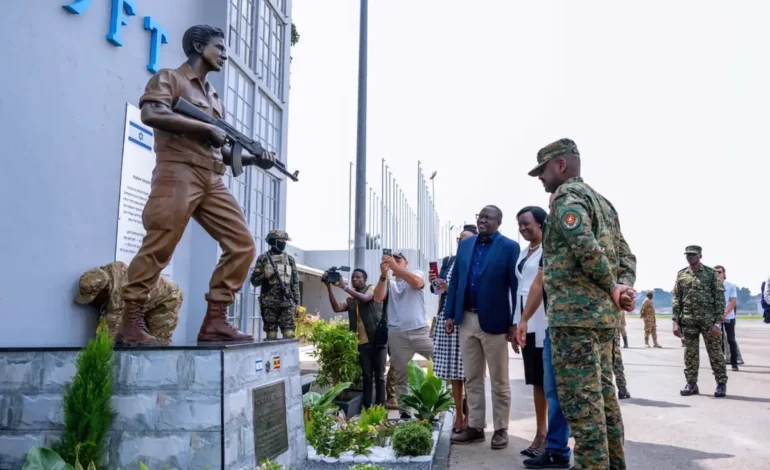
Uganda’s military has officially unveiled a statue of Lt. Col. Yonatan “Yoni” Netanyahu at the old Entebbe Airport terminal, the exact location where he was fatally shot while leading Israeli commandos during the famous 1976 Entebbe hostage rescue mission. The ceremony was led by Uganda’s Chief of Defence Forces, Gen. Muhoozi Kainerugaba, who described the monument as a tribute to courage, sacrifice and duty.

Yonatan Netanyahu was the elder brother of Israeli Prime Minister Benjamin Netanyahu and commander of Israel’s elite Sayeret Matkal special forces unit. He remains the only Israeli soldier killed during the operation, which has since become one of Israel’s defining military victories.

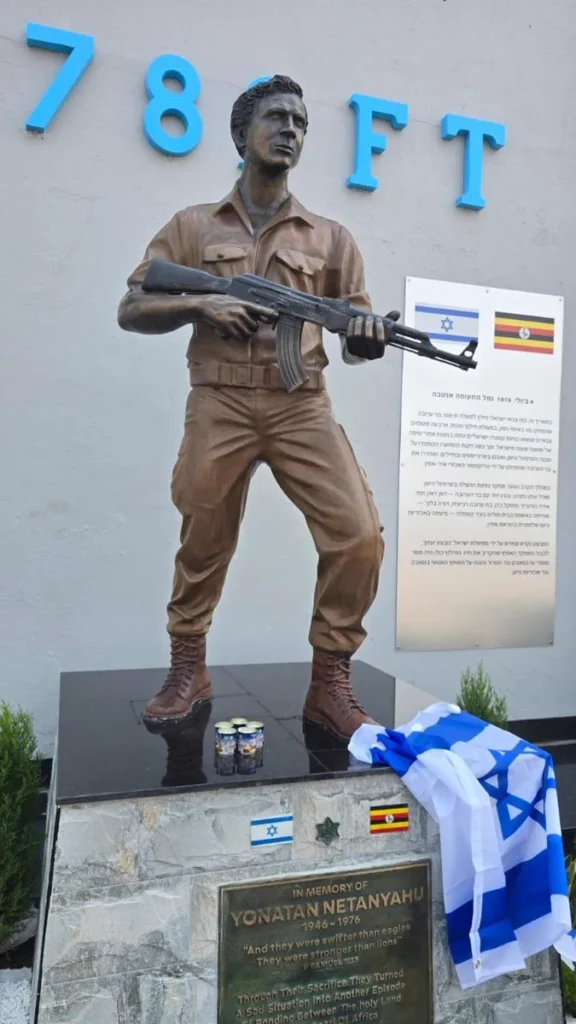
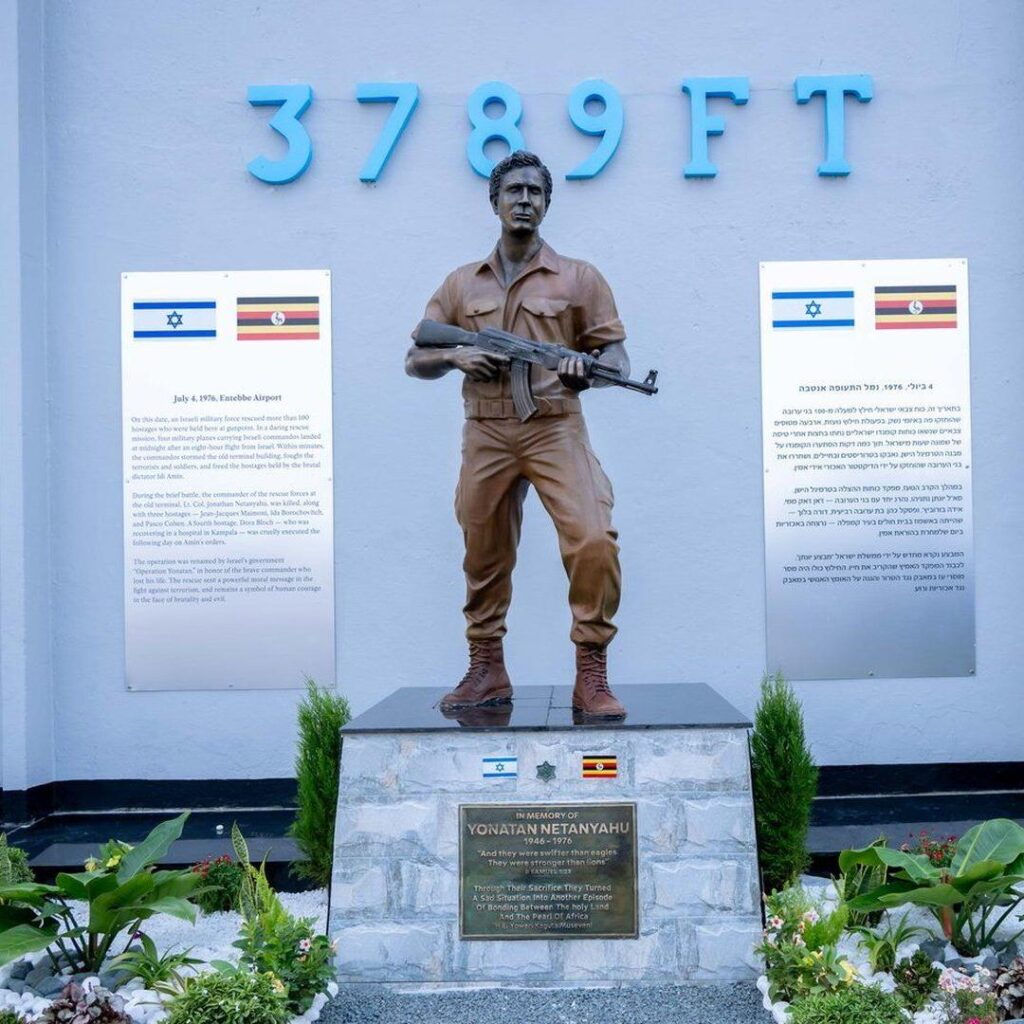
The monument depicts Netanyahu carrying an assault rifle and now stands outside the old airport terminal where the dramatic events unfolded almost 50 years ago.

Speaking during the unveiling, Gen. Kainerugaba said the memorial was intended to honour the values Netanyahu represented.
“Today, this memorial stands not only in remembrance of a distinguished soldier, but also as a tribute to the enduring values he embodied: courage in the face of danger, unwavering commitment to protecting innocent lives, and steadfast devotion to duty,” he said.

The ceremony was attended by Ugandan military officials and Israeli guests, reflecting what both sides describe as increasingly warm relations between Kampala and Tel Aviv.
The story behind the statue dates back to July 1976. An Air France flight travelling from Tel Aviv to Paris was hijacked by two Palestinian and two German militants before being diverted to Entebbe Airport in Uganda.
At the time, Uganda was ruled by military dictator Idi Amin, who had severed relations with Israel and openly supported the Palestinian cause. The hijackers separated Israeli and Jewish passengers from the other hostages and demanded the release of Palestinian prisoners held by Israel.
After days of negotiations, Israeli commandos launched a surprise nighttime assault on Entebbe Airport.
The raid rescued 106 hostages in less than an hour and stunned the world with its precision. Three hostages died during the rescue, dozens of Ugandan soldiers were killed, and Yonatan Netanyahu was fatally wounded while leading the assault team. Israel later renamed the mission Operation Yonatan in his honour.
For Uganda, however, the operation has always carried a more complicated legacy.
The Organisation of African Unity—predecessor to today’s African Union—condemned the Israeli raid at the time, viewing it as a violation of Uganda’s sovereignty despite widespread international admiration for the hostage rescue itself.
Relations between Uganda and Israel have changed dramatically since the days of Idi Amin.
President Yoweri Museveni, who came to power in 1986, restored diplomatic ties with Israel, and cooperation between the two countries has steadily expanded in areas including agriculture, technology, security and defence. Museveni has also publicly expressed support for a two-state solution to the Israeli-Palestinian conflict.
Gen. Kainerugaba—widely regarded as his father’s likely successor—has emerged as one of Israel’s strongest supporters on the continent. Earlier this year, he announced plans for the statue, describing it as a symbol of the close friendship between Uganda and Israel. The unveiling is likely to generate mixed reactions across Africa.
Supporters see it as recognition of one of history’s most remarkable hostage rescue missions and a reflection of Uganda’s sovereign right to honour figures it considers significant to its national history.
Critics, however, argue that commemorating a foreign military commander killed during an armed operation on Ugandan soil risks reopening painful historical memories tied to the country’s turbulent past under Idi Amin.
Regardless of differing opinions, the monument ensures that the events of Entebbe in 1976—and the man who led one of the world’s most famous rescue operations—remain permanently etched into Uganda’s history..
RELATED: