Faith Nyasuguta

Less than four years after a fragile peace agreement ended a devastating civil war in northern Ethiopia, anxiety is once again spreading across the Tigray region. With tensions rising between federal forces and local authorities, civilians are beginning to leave – unwilling to wait for another war to erupt before seeking safety.
In the dead of night in Mekelle, the regional capital, bus stations have become scenes of quiet urgency. Dozens of young men carrying backpacks and small suitcases search for transport to Ethiopia’s capital, Addis Ababa. Some hope to leave immediately while others simply want to be ready.

Their movements reflect a growing fear that the region could soon slide back into violence.

While global attention remains fixed on conflicts elsewhere -particularly across the Red Sea in the Middle East – warning signs are emerging in the Horn of Africa. Federal Ethiopian forces and fighters aligned with Tigray are reportedly positioning themselves along their shared front lines, reviving memories of the brutal war that ended in November 2022.


That conflict killed tens of thousands, displaced millions and devastated much of the region’s infrastructure. Although the Pretoria peace agreement formally ended the fighting, many of its key provisions were never fully implemented. Political mistrust has lingered, and relations between Ethiopia and neighboring Eritrea – whose forces were deeply involved in the earlier war – have also deteriorated.
Against this tense backdrop, departures from Tigray are quietly increasing.

Precise figures are difficult to verify, but residents say hundreds of people are leaving daily, traveling by bus or plane out of a region that was home to roughly six million people before the war.
Economic pressures are adding to the sense of crisis.
Basic goods are becoming harder to find, and the cost of essential supplies is climbing sharply. In Mekelle, street vendors openly sell smuggled petrol at roadside intersections. It is said that prices have surged in just a few days – from about 300 birr to 430 birr per bottle.
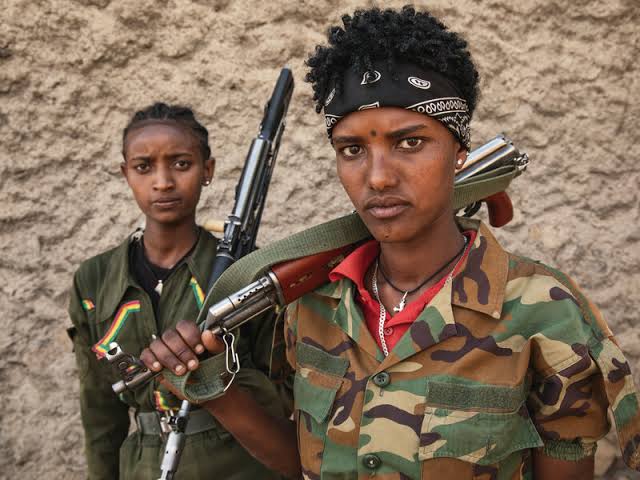
The region is also grappling with deep financial strain. Federal authorities have reportedly cut subsidies to Tigray for several months, leaving many public workers without salaries. Banks, meanwhile, are running short of cash.
South of Mekelle, reminders of the previous war remain scattered across the landscape. On the road toward southern Tigray, the rusting wreckage of a destroyed tank sits abandoned by the roadside.
Further along lies Chercher, a town of about 50,000 people located roughly 150 kilometres from the capital. Positioned near the borders of the Afar and Amhara regions, Chercher has become a focal point of new fears. Residents say federal troops have been gathering nearby.
In January, a brief outbreak of fighting in the area rattled the community and revived memories of the earlier conflict. For many, the echoes of artillery were enough to trigger panic.
Mahlet Terefe, a 23-year-old mother, temporarily fled the town with her three-year-old son when the shelling began. She eventually returned to reopen her small stall selling juice and alcohol, but business has nearly disappeared.
“As you can see it’s deserted, there is nobody around,” she said.The empty streets only deepen her anxiety. “I want to leave with my boy before war starts. I’m very afraid.”
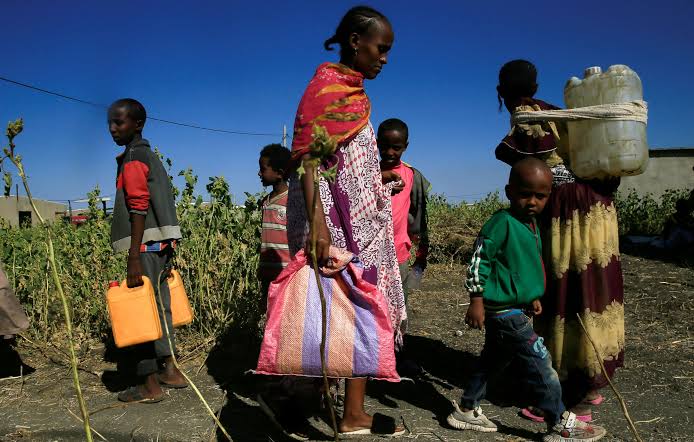
Local officials share similar concerns. Zinabu Gebredhin, an administrator in Chercher, believes the situation is deteriorating quickly.
“There will be a new war,” he warned. “Federal forces have mobilised soldiers nearby.”
According to him, the nearest federal army base is just 23 kilometres from the town, while troops are positioned on surrounding hills roughly 10 kilometres away. Both the Ethiopian federal government and Tigrayan authorities accuse each other of escalating the crisis.
Amanuel Assefa, deputy leader of the Tigrayan People’s Liberation Front (TPLF) – the political force that has long dominated the region – said the situation appears increasingly dangerous.
“The federal troops are advancing from all corners of Ethiopia, and I can say that Tigray is being encircled by federal troops,” he said. “The highly likely scenario seems that there will be a conflict.”
Ethiopian Prime Minister Abiy Ahmed has attempted to calm fears, saying he does not want a return to war. In an unusual move, he recently delivered a speech in Tigrinya, the language widely spoken in Tigray.
Yet his message also included criticism of the TPLF, saying the group “wasn’t ready to make even a small compromise.” For many residents, the political accusations matter little compared to the possibility of renewed violence.
In Chercher’s nearly empty marketplace, 50-year-old Berhan Adhana quietly runs a small spice stall despite the dwindling crowds.
She says the region has already paid too high a price. “War is destructive, it destroys countries,” she said.
“There is nothing we will gain from war.”
RELATED: