Wayne Lumbasi

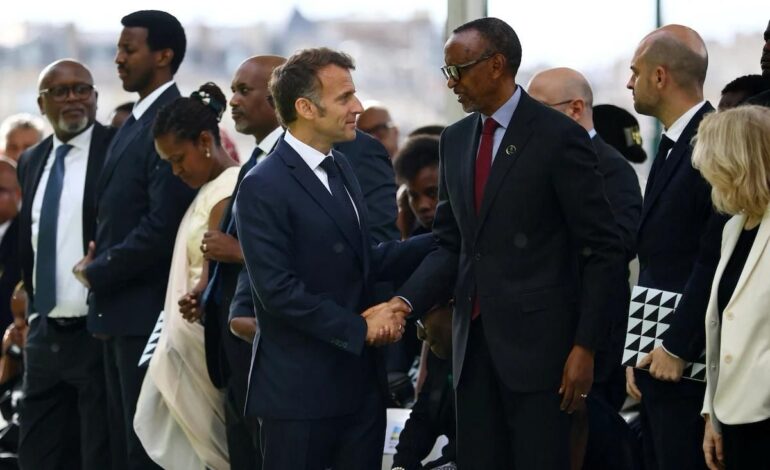
French President Emmanuel Macron and Rwandan President Paul Kagame jointly inaugurated France’s first permanent public memorial to the 1994 genocide against the Tutsi on Tuesday, marking a historic milestone in the long and painful reconciliation between the two nations.
The monument, titled L’Archive, stands on the Esplanade Habib-Bourguiba along the banks of the Seine River in central Paris. Designed by Berlin-based artist Grada Kilomba, the contemporary memorial features large, minimalist black brass steles resting on volcanic lava stone. It bears inscriptions in French, English, Kinyarwanda and Swahili to honor the estimated 800,000 to one million Tutsi slaughtered over 100 days between April and July 1994.

Addressing a gathering of dignitaries, historians, and genocide survivors, President Macron described the monument as the culmination of a long and patient quest for truth. He emphasized that the memorial firmly roots the memory of the genocide against the Tutsi at the heart of the French capital and its collective history. Macron further pledged that France would continue to pursue justice, reaffirming that the country would not become a sanctuary for fugitives accused of participating in the massacres.

President Kagame delivered a powerful address that re-framed decades of diplomatic tension, stating that the willingness to confront historical facts was ultimately more valuable than a formal apology. For nearly three decades, bilateral relations between Paris and Kigali were deeply strained by allegations that France bore complicity in the genocide due to its political and military support for the Hutu-led regime at the time. Kagame’s remarks signal a pragmatic transition in Franco-Rwandan diplomacy, prioritizing shared memory and structural accountability over rigid legalistic declarations.

The joint inauguration builds heavily upon the groundwork laid by the 2021 Duclert Commission, an independent historical panel commissioned by Macron. The landmark report concluded that France bore serious and overwhelming responsibility for failing to prevent the impending slaughter, though it found no evidence of direct complicity. Macron’s subsequent visit to Kigali in 2021, where he acknowledged France’s failures and asked survivors for forgiveness, paved the way for the total restoration of diplomatic ties.
Following the ceremony, President Kagame was hosted at the Élysee Palace for an official dinner, cementing a profound geopolitical pivot in East African relations. The permanent presence of L’Archive in Paris stands as a tangible symbol of a diplomatic relationship once completely severed, but now reconstructed through a mutual commitment to historical truth.

RELATED: