Faith Nyasuguta

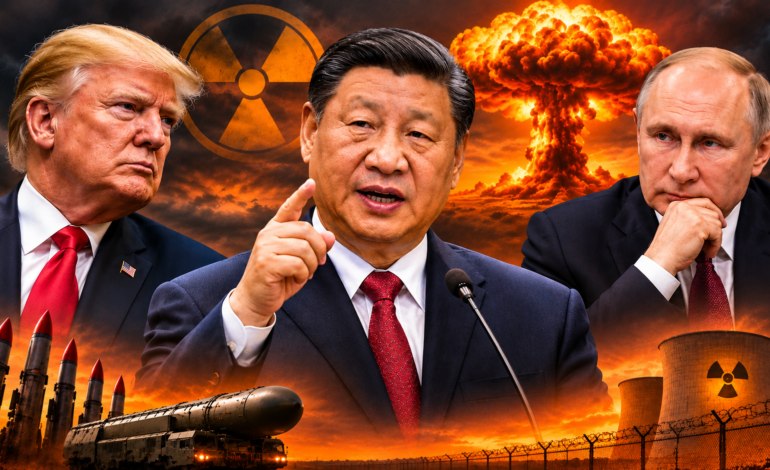
Imagine three of the world’s most powerful leaders, whose countries collectively possess thousands of nuclear warheads, sitting around one table discussing why nuclear weapons should disappear from the planet.
That is the extraordinary contradiction emerging from a reported historic meeting between Chinese President Xi Jinping, US President Donald Trump and Russian President Vladimir Putin.

At the gathering, reportedly held at Kylin Villa in Shenzhen, China, on November 19, 2026, Xi called for the comprehensive prohibition and total elimination of nuclear weapons. His message was unmistakable: humanity cannot afford a nuclear war.

But there is an uncomfortable question hanging over the declaration. If nuclear weapons are so dangerous, why are the countries calling for their elimination still holding on to them?

A Nuclear-Free World, According to Nuclear Powers
During the reported 90-minute meeting, Xi described nuclear weapons as a threat hanging over humanity and urged major powers to pursue peaceful coexistence, mutual respect and diplomatic dialogue. He reiterated the principle that nuclear war cannot be won and must never be fought.

Trump reportedly welcomed discussions on reducing nuclear weapons, while Putin emphasised the responsibility of major powers to maintain global stability.
The three leaders were said to have issued a joint declaration supporting nuclear-risk reduction and non-proliferation. However, the reported declaration contained no binding timetable for eliminating nuclear arsenals.
No specific number of warheads was earmarked for destruction. And no enforceable disarmament mechanism was announced. For all the diplomatic symbolism, the world’s nuclear weapons remain firmly in place.
How the World Became Hostage to Nuclear Weapons
The nuclear age began in 1945, when the United States dropped atomic bombs on Hiroshima and Nagasaki. Four years later, the Soviet Union tested its first nuclear weapon. China followed in 1964.
What began as a military breakthrough rapidly became a global competition over who could build the most devastating weapons. During the Cold War, Washington and Moscow accumulated enormous nuclear stockpiles, creating the possibility of destroying entire cities within minutes.
Decades of arms-control agreements eventually reduced those arsenals. Yet the world’s nuclear powers never abandoned the weapons themselves.
Today, the United States and Russia still possess the overwhelming majority of the world’s nuclear warheads, while China continues expanding and modernising its capabilities.
The expiration of the New START treaty in February 2026 removed a major remaining framework limiting American and Russian strategic nuclear arsenals. Against that backdrop, renewed nuclear diplomacy is important. But diplomacy without measurable commitments risks becoming little more than political theatre.
China Wants Disarmament, But Its Arsenal Is Growing
Xi’s position is not entirely new. China has advocated the eventual elimination of nuclear weapons for decades, including through its support for the Nuclear Non-Proliferation Treaty.
In 2017, Xi publicly called for nuclear weapons to be comprehensively prohibited and completely destroyed. Yet China has simultaneously invested in expanding its nuclear forces.
Beijing argues that its nuclear capabilities are necessary for national defence and strategic deterrence. Washington and Moscow make similar arguments about their own arsenals. And therein lies the contradiction.
Every nuclear power claims its weapons are necessary for security, while insisting the world would be safer without them. The result is a global security system in which possessing weapons capable of mass destruction is treated as a source of political influence.
Africa Rejected Nuclear Weapons. Why Can’t the Superpowers?
For Africa, the debate is particularly revealing. The continent has experienced the consequences of nuclear militarisation without enjoying the strategic privileges associated with possessing nuclear arsenals.
France conducted nuclear tests in Algeria during the colonial period, exposing communities and environments to radioactive contamination. South Africa developed nuclear weapons under apartheid before voluntarily dismantling them.
Today, the Treaty of Pelindaba establishes Africa as a nuclear-weapon-free zone. African countries have therefore demonstrated a collective commitment to keeping nuclear weapons off the continent. Yet the world’s major powers continue treating nuclear deterrence as indispensable.
This raises a difficult question about international double standards. Why should nuclear disarmament be considered achievable for African countries but remain politically unrealistic for the most powerful nations?
Historic Summit or Historic Hypocrisy?
The reported Shenzhen meeting could represent an important opportunity to reopen dialogue among Washington, Moscow and Beijing. At a time of growing geopolitical tensions, communication between nuclear powers matters. But declarations alone do not dismantle warheads.
Real progress would require verifiable reductions, binding agreements, transparency and sustained political commitment. Without those measures, the world’s most powerful countries risk repeating the same promises they have made for decades.
They condemn nuclear weapons as an existential threat while continuing to rely on them. They call for peace while maintaining the ability to wage catastrophic war. And they demand international restraint while defending their own nuclear capabilities.
Xi Jinping has called for the destruction of nuclear weapons while sitting alongside Trump and Putin. But if the world’s nuclear powers genuinely believe these weapons threaten humanity, why are they still unwilling to surrender their own?
RELATED: