
Wayne Lumbasi

A Kenyan tribunal has dismissed a legal challenge seeking greater scrutiny of Nigerian billionaire Aliko Dangote’s planned $16 billion oil refinery in Lamu County, removing one of the legal obstacles facing the massive industrial project.
The Public Private Partnerships Petition Committee rejected a petition filed by the Consumers Federation of Kenya (COFEK), which had questioned the financing arrangements, proposed government involvement and transparency surrounding the refinery.

The consumer organisation wanted the government to disclose agreements, feasibility studies, risk assessments and other documents explaining Kenya’s proposed financial participation in the project. It also sought clarification on the reported government stake, the source of public funds and any commitments involving public land, infrastructure or guarantees.

The committee ruled that COFEK had failed to demonstrate that the refinery qualified as a Public Private Partnership (PPP) under Kenya’s Public Private Partnerships Act. It consequently found that it had no jurisdiction to determine the petition or compel the disclosure of the requested documents through those proceedings.

A key issue was whether the government’s possible investment in the refinery automatically made it a public-private partnership. The committee determined that government equity participation alone does not transform a privately owned commercial investment into a PPP.
National Treasury Cabinet Secretary John Mbadi told the committee that the refinery was being developed, financed, owned and operated by Dangote’s investment group, which would carry the commercial risks. He explained that discussions about possible government participation were ongoing, but any investment would be governed by public investment laws rather than the PPP Act.

Dangote’s representative, Peter Lazarus, also maintained that the project was a private commercial investment and that there was no arrangement to transfer ownership of the refinery to the Kenyan government.
A $16 Billion Industrial Project
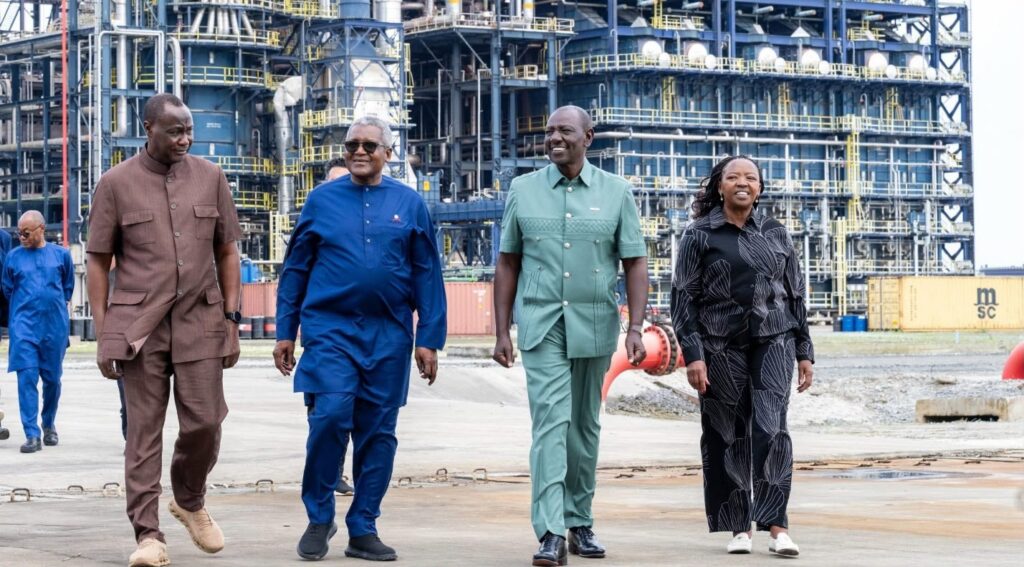
The proposed refinery, valued at approximately $16 billion (KSh2.2 trillion), is planned for Lamu County and is expected to process up to 700,000 barrels of crude oil daily. It is designed to supply petroleum products to Kenya and other markets across East and Central Africa, potentially reducing the region’s reliance on imported refined petroleum.
Beyond oil refining, the proposed industrial complex will include petrochemical and fertiliser manufacturing facilities, storage infrastructure, pipelines and a 1,000-megawatt power plant.
Construction is expected to take approximately 40 months, with commissioning targeted for early 2030. President William Ruto and Dangote presided over the project’s groundbreaking ceremony on September 30, 2026.
Other Legal Disputes Remain Unresolved
Despite the tribunal’s decision, the refinery continues to face separate legal questions, particularly concerning land rights.
In another case, 133 residents of Chandavai in Lamu County challenged the use of land earmarked for the development, arguing that it constitutes ancestral territory occupied and used by their families for generations.
The residents have raised concerns about compensation, displacement, resettlement and the protection of their livelihoods. These issues are being handled separately through the Environment and Land Court and were not determined by the PPP Petition Committee.
Consequently, the latest ruling does not amount to blanket approval of every aspect of the refinery or resolve all disputes surrounding its development.
The decision nevertheless removes a significant legal challenge to the project’s financing classification, allowing Dangote’s proposed East African industrial investment to move forward without the PPP proceedings initiated by COFEK.
RELATED: