Wayne Lumbasi

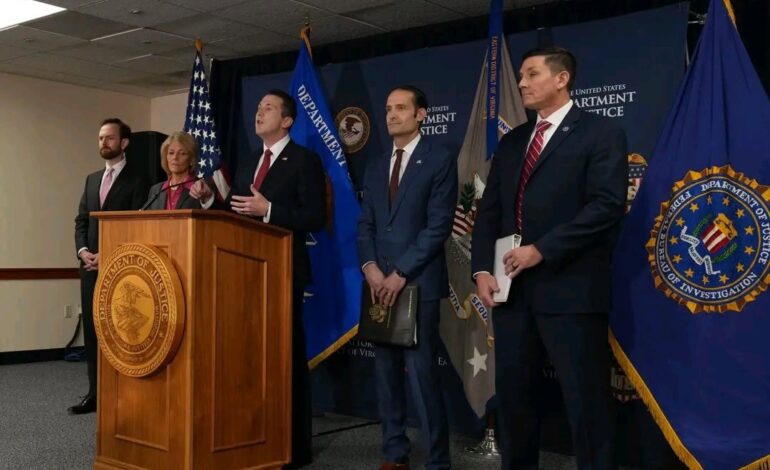
The United States Department of Justice has uncovered an alleged international student-aid fraud scheme estimated to have cost American taxpayers more than $200 million, with investigators identifying networks operating between the United States and Kenya.
The investigation, conducted under an operation dubbed Operation Ghostbusters, has exposed how criminals allegedly exploited the country’s federal student financial aid system using fake university enrolments, stolen identities and fraudulent applications to obtain government-funded student loans and grants.

According to the Justice Department, the scheme involved creating fictitious student accounts using the personal information of unsuspecting American citizens. The identities were then used to submit applications for federal financial assistance through the Free Application for Federal Student Aid (FAFSA) programme.

Once the applications were approved, the fraudsters allegedly used the fake enrolments at colleges and universities to access the funds. The money was subsequently withdrawn or redirected into bank accounts controlled by individuals involved in the operation, despite the supposed students never genuinely attending classes or pursuing their studies.

Investigators say some of the networks also exploited technology, including artificial intelligence, to complete coursework and create the impression that the fictitious students were actively participating in their academic programmes.
Kenya has emerged as an important part of the investigation, with American authorities alleging that individuals based in the country worked alongside accomplices in the United States to obtain stolen identities, facilitate fraudulent enrolments and transfer proceeds from the scheme across international borders.

In one case involving New Jersey, three defendants were charged over an alleged conspiracy to obtain more than $1 million in federal student-aid funding. Prosecutors allege that the money was received through American bank accounts before being transferred to associates in Kenya, linked to a purported Kenyan safari company.
In another case in Virginia, a Kenyan national was indicted over an alleged operation involving more than 700 fraudulent student-aid refund deposits valued at approximately $1.44 million. Investigators say the money was moved through thousands of transactions involving accounts in both the United States and Kenya.
A separate investigation in Nebraska has also implicated Kenyan citizen Francis Mogambi, who faces charges relating to the alleged theft of government funds and aggravated identity theft. According to prosecutors, Mogambi allegedly worked with associates in Kenya to steal American identities, create fictitious student enrolments and redirect financial-aid payments. He is accused of retaining 30 per cent of the proceeds while transferring the remainder to associates in Kenya.
The investigation has also resulted in the seizure of more than $750,000 in cryptocurrency from an account belonging to a Kenyan national allegedly connected to the scheme. The recovery, equivalent to approximately KSh97 million, was conducted with assistance from Kenyan law-enforcement agencies and marks an important development in efforts to trace funds moved beyond African borders.

The US Justice Department is working with Kenya’s Directorate of Criminal Investigations, the Asset Recovery Agency and the Office of the Director of Public Prosecutions to investigate the alleged networks, trace financial transactions and identify other individuals who may have participated in the operation.
The scale of the suspected fraud extends beyond the individual criminal cases. Investigators identified approximately 830,840 potentially fraudulent federal student-aid identification accounts associated with nearly $130 million during September and October 2026. Authorities recommended disabling the suspicious accounts to prevent further exploitation of the financial-aid system.
The FBI has also identified more than $32 million in losses connected to ghost-student schemes, with investigations continuing across multiple American states. More than 40 active investigations have reportedly been opened through FBI field offices and US Attorneys’ Offices.
The five defendants charged in the initial cases face various allegations, including conspiracy, identity theft, wire fraud and theft of government money. The Justice Department has indicated that investigations are ongoing and that further individuals could face prosecution.
The case has raised concerns about the vulnerability of digital education and financial-aid systems, particularly how stolen identities and fictitious enrolments can be used to divert public resources intended to support genuine students.
For Kenya, the investigation highlights the alleged involvement of individuals and business networks in an international financial crime operation, as authorities on both sides work to establish the full extent of the activities and recover the money.
While the estimated $200 million represents the wider suspected scale of the fraud, investigators are still working to establish the total amount stolen and identify everyone involved.
RELATED: