Njoki Kangethe

A forest can look like a single thing from a distance. A green mass on the side of a mountain, perhaps, stretching into the horizon. But get closer and the question of who owns it becomes surprisingly complicated. There may be government officials responsible for its protection, communities whose lives have been intertwined with it for generations, private companies managing plantations, farmers cultivating land along its edges, and people who depend on the forest for water, medicine, food, fuel or income.
So when we ask who owns a forest, we are really asking something larger: who has the right to make decisions about it, who benefits from those decisions, and who bears the cost when those decisions go wrong?

Kenya’s forest law recognises three broad categories of forest: public, community and private. Public forests are generally managed by the Kenya Forest Service, while community forests are vested in the communities that own them and private forests belong to their registered owners. The Forest Conservation and Management Act, 2016 also recognises customary rights and defines a forest community as people with a traditional association with a forest for livelihood, culture or religion.

On paper, then, the architecture is relatively clear. In practice, forests do not always fit neatly into categories drawn on maps and legal documents.

Take public forests. The Kenya Forest Service has the mandate to conserve, protect and manage them, prepare management plans and oversee the issuing of licences and permits. But even here, the law does not imagine the government as the only actor. Public participation and community involvement are explicitly listed among the guiding principles of forest management, and forest conservation committees include representatives from community forest associations, forest industries and civil society. This is where Community Forest Associations, or CFAs, become important.
A CFA is essentially a way of formalising the relationship between communities living around forests and the institutions responsible for managing them. Under the law, members of a forest community can form an association and apply to participate in the conservation and management of a public forest. If approved, the association can enter into a management agreement with the Kenya Forest Service and exercise specified user rights. These can include collecting medicinal herbs, harvesting honey, gathering firewood, grazing, ecotourism and developing community-based forest enterprises, subject to conservation requirements.

The idea is significant because it acknowledges something that a purely bureaucratic approach to conservation can easily miss: the people living beside a forest are not simply people who happen to be near it. Their daily lives may already be connected to it.
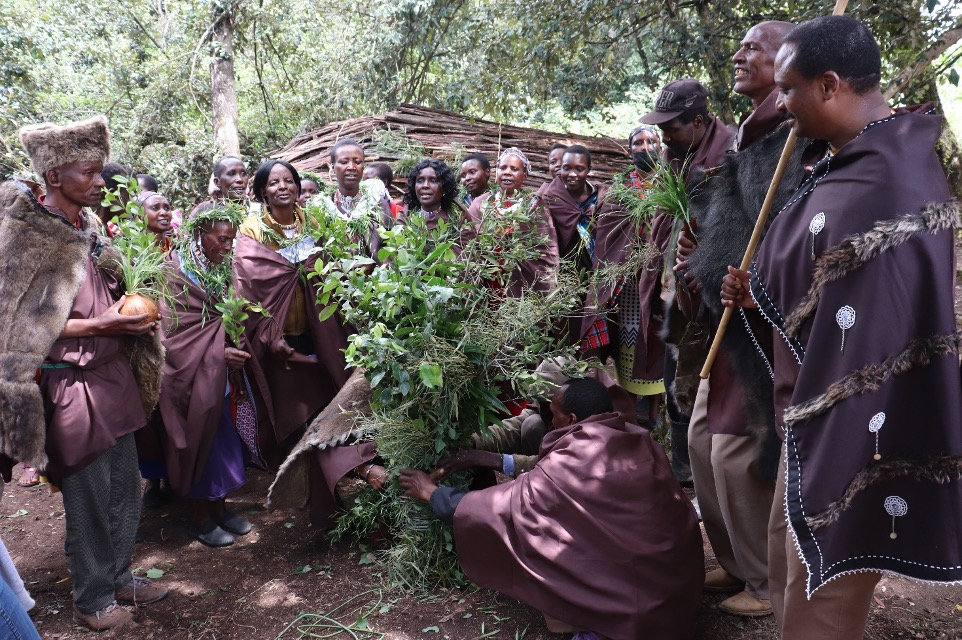
Kenya’s own participatory forest management guidelines recognise this. The process involves identifying the community resource, strengthening community forest associations, assessing the forest and surrounding community, developing management plans, negotiating management agreements, implementing them and monitoring their impact.
There are examples of this model operating in different parts of the country. In 2024, the Kenya Forest Service launched participatory forest management plans and signed management agreements with community associations in several forests in Meru County. The associated programmes included beekeeping, ecotourism, fruit farming and tree nurseries as livelihood activities alongside conservation. KFS says it currently has 177 approved forest management plans and 77 forest management agreements supporting community participation.
But participation is not the same thing as ownership, and neither automatically guarantees good management.
The experience of the Nanyuki Community Forest Association illustrates the point. In 2024, the Kenya Forest Service reported that the association had held elections following complaints about mismanagement and a lack of transparency among its officials. The forest serves thousands of neighbouring households, with communities using it for activities including tree nurseries, ecotourism, beekeeping, herbal medicine, grazing and firewood collection.
This is an important reminder that “community” is not a synonym for “perfectly managed”. Communities contain different interests, power structures and disagreements, just as governments and companies do. Participatory management therefore requires more than simply inviting local people into a meeting. It requires transparent institutions, clear rules, accountable leadership and meaningful benefit sharing.
There is another layer to the question of forest ownership, particularly in places such as the Mau Forest Complex: the relationship between the state and Indigenous communities whose connection to the forest predates modern conservation boundaries.
The Ogiek, for example, have a longstanding relationship with the Mau forests. The question of their rights has been the subject of litigation and international attention for years. In 2024, the United Nations Permanent Forum on Indigenous Issues called on Kenya to strengthen the participation of Indigenous Peoples in sustainable forest management and to implement equitable land-tenure arrangements in relation to the Ogiek.
This history complicates the idea that a forest becomes someone’s simply because a government document says so. Modern conservation has often depended on creating boundaries, designating protected areas and establishing institutions to manage them. But forests existed before these administrative systems, and people developed relationships with them long before the language of ‘forest management’entered government policy.
There is also a practical economic question. A forest can generate value without being felled. Honey can be harvested. Tourism can generate income. Medicinal plants can support livelihoods. Water catchments can sustain agriculture and cities far beyond the forest boundary. Carbon and biodiversity have economic value too. The challenge is ensuring that the people who help keep forests standing actually share in some of that value.
Kenya’s law recognises this principle through benefit-sharing arrangements and through the user rights available to participating community associations. KFS also identifies community-based forest industries, non-wood forest products and participatory management as part of its forestry work.
This matters because conservation becomes much harder to sustain when the costs are local but the benefits are distant. If a community is asked to protect a forest while receiving little economic benefit from doing so, conservation can begin to feel like a restriction imposed from elsewhere. But when communities have a genuine stake in a forest’s future, the forest can become an asset worth defending.
None of this means forests should simply be handed over to whoever lives nearest to them. Forests provide public goods that extend far beyond their immediate neighbours. A water tower does not belong only to the village beside it; the water it regulates may eventually reach millions of people. Nor does a forest’s carbon storage, biodiversity or ecological function stop at an administrative boundary.
The real challenge, therefore, is not choosing between government and communities, or between conservation and livelihoods. It is designing institutions capable of holding these interests together.
A forest needs someone responsible for it. But responsibility should not mean exclusion, and community participation should not mean the absence of rules. The strongest systems are likely to be those in which ownership, authority, access and benefit are clearly defined, and where the people who depend on forests have a meaningful role in determining their future.
Perhaps that is the more useful question to ask when the next forest is threatened with logging, development or conversion: not simply, ‘Who owns this land?’ Ask instead: Who has a stake in keeping this forest alive, who has the power to decide what happens to it, and what do they stand to gain or lose?
Because a forest may have one legal owner. Its consequences, however, belong to all of us.
References
• Kenya Law, Forest Conservation and Management Act, 2016.
• Kenya Forest Service, Participatory Forest Management Guidelines.
• Kenya Forest Service, Participatory Forest Management Plans.
• Kenya Forest Service, Launch of Participatory Forest Management Plans, 2024.
• Kenya Forest Service, Forest Management Plans.
• United Nations Permanent Forum on Indigenous Issues, Kenya recommendations, 2024.
• CIFOR, Involving communities in forest management planning in Kenya.s
RELATED: