
Wayne Lumbasi

A group of white former commercial farmers from Zimbabwe has formally appealed to U.S. President Donald Trump to intervene in efforts to recover $3.5 billion owed by the Zimbabwean government for properties seized during the country’s land reform programme.
The claim stems from Zimbabwe’s fast-track land reform, launched in the early 2000s, which resulted in the compulsory acquisition of thousands of white-owned commercial farms. The programme radically altered land ownership patterns but also led to a sharp decline in large-scale agricultural output and years of legal disputes between the state and displaced farmers.

In July 2020, the Zimbabwean government signed a Global Compensation Deed with representatives of former farmers, committing to pay $3.5 billion as compensation for infrastructure and improvements on the farms, including houses, barns, irrigation systems, dams and equipment. The agreement explicitly excluded compensation for the land itself, which the state maintains was reclaimed under constitutional authority.

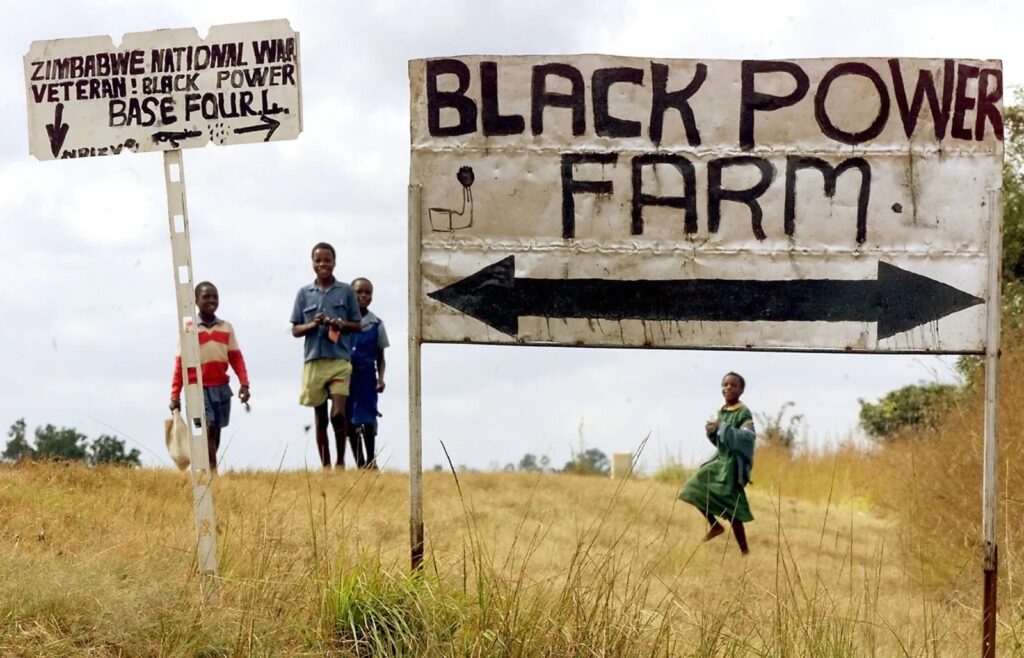
A “Black Power Farm” sign in a rural area of Zimbabwe, an occupied property that became a focal point during the country’s controversial land reform program around the year 2000/NP/
Despite the agreement, payments have been limited. Zimbabwe has cited severe fiscal constraints, high external debt and restricted access to international credit markets as reasons for the slow rollout. Initial compensation payments began several years later and have largely taken the form of US-dollar-denominated Treasury bonds, with only small portions paid in cash. A significant share of the total amount remains unpaid.

Farmer representatives argue that the bond-based payments do not meet the terms or expectations of the compensation deal, pointing to long maturities and limited liquidity. As a result, they have turned to the United States, seeking assistance from President Trump’s administration to help enforce or accelerate the settlement of the outstanding amount.
The appeal is linked to Zimbabwe’s broader efforts to normalise relations with international financial institutions. Compensation of former farmers is one of the conditions tied to debt restructuring discussions and renewed access to multilateral financing.

Within Zimbabwe, the compensation process continues amid economic strain marked by inflation, currency instability and pressure on public finances. The government has maintained that compensation will proceed in phases as resources allow.
As the farmers pursue international pressure to recover the full $3.5 billion, the issue remains a central factor in Zimbabwe’s economic re-engagement efforts and its long-running land reform legacy.
RELATED: