Wayne Lumbasi

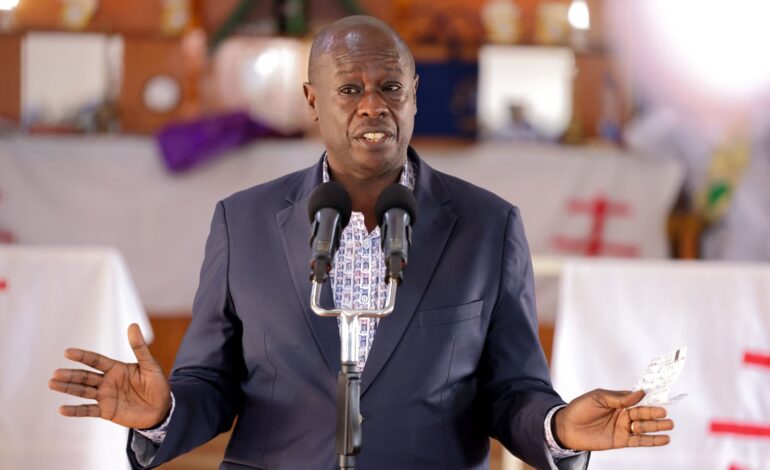
Kenya’s political tensions deepened on Sunday after former Deputy President Rigathi Gachagua claimed he was the target of an assassination attempt during a violent incident at a church service in Nyeri County, an allegation that has triggered a police investigation and sharp political reactions across the country.
The incident occurred at an Anglican Church in Othaya, where Gachagua was attending a Sunday service alongside supporters. According to the former deputy president, chaos erupted when unidentified individuals disrupted the gathering, deploying tear gas and firing shots within the church compound. The disturbance sent worshippers scrambling for safety, forcing the service to come to an abrupt halt.

Gachagua said his convoy was attacked and several vehicles vandalised as security forces allegedly sealed off the area, trapping him and other congregants inside the church for a period of time. In a series of social media posts during and after the incident, he accused the government of orchestrating the attack, claiming that state-linked operatives had been sent to eliminate him. He warned that any attempt on his life would have serious consequences for national stability.

Videos shared online showed clouds of tear gas drifting across the church grounds as congregants, including women and children, fled in distress. The scenes sparked public outrage, particularly over the use of force in a place of worship. Gachagua later confirmed that he had managed to leave the area safely and was secure at his residence.

The government has denied any involvement in an assassination plot but acknowledged that the events in Othaya were unacceptable. Interior Cabinet Secretary Kipchumba Murkomen ordered an immediate investigation, directing the National Police Service and its Internal Affairs Unit to establish what happened and who was responsible. Police officials said inquiries were underway but stopped short of confirming whether officers were involved in the use of tear gas or live ammunition.
The incident has drawn condemnation from across the political spectrum. Opposition leaders described the attack as a dangerous escalation of political intolerance and a violation of constitutional freedoms, while urging the government to guarantee the safety of all political actors regardless of affiliation. Calls have also emerged from civil society and religious leaders demanding accountability and restraint, warning that political violence threatens Kenya’s democratic fabric.

The church confrontation comes against the backdrop of strained relations between Gachagua and President William Ruto following Gachagua’s impeachment in 2024 and his subsequent repositioning as a vocal critic of the administration.The episode reflects rising political temperatures as the country edges closer to the 2027 general elections, with concerns growing over the politicisation of security agencies and shrinking civic space.
As investigations continue, the Othaya church attack has become a flashpoint in Kenya’s political discourse, raising pressing questions about political tolerance, the role of security forces, and the protection of fundamental freedoms in an increasingly polarised environment.
RELATED: