Faith Nyasuguta

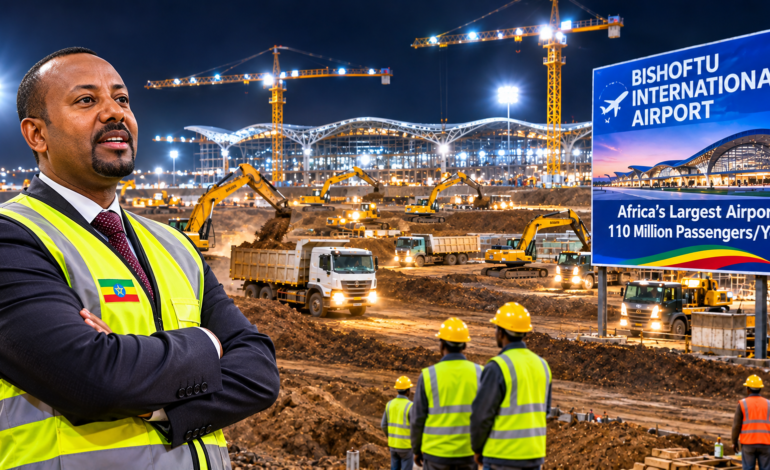
Ethiopia is accelerating work on its multibillion-dollar Bishoftu International Airport, with construction crews operating through the night as the country pushes ahead with what is planned to become Africa’s largest airport by passenger capacity.
Prime Minister Abiy Ahmed said there is extensive activity at the construction site, highlighting the scale and intensity of operations. He mentioned fleets of excavators, bulldozers and heavy-duty trucks moving across vast stretches of land. Even after sunset, machinery continues operating under powerful floodlights, demonstrating the government’s determination to maintain construction momentum.

In his latest update, Abiy described the project as Africa’s largest aviation infrastructure undertaking, emphasising that work is progressing continuously. The footage provides a glimpse into the enormous engineering effort required to transform the site into a major international aviation complex.

Ethiopia’s Ambition Goes Beyond Building an Airport

Located approximately 40 kilometres southeast of Addis Ababa, near Bishoftu, the airport is being developed to accommodate Ethiopia’s expanding aviation ambitions. Once fully completed, the facility is designed to handle up to 110 million passengers annually. That would place it among the world’s largest airports by passenger capacity.
However, the figure represents the airport’s planned ultimate capacity, not its expected passenger traffic immediately after opening. The first phase, targeted for completion around 2030, is designed to accommodate approximately 60 million passengers annually.

It is expected to include two parallel runways, with the full development eventually expanding to four.
The project also envisages aircraft parking facilities capable of accommodating approximately 270 aircraft. These ambitious specifications reflect Ethiopia’s strategy to position itself as a major gateway connecting Africa with international markets.
Why Construction Speed Matters
The latest update signals an important shift from project announcements and planning discussions towards visible construction activity. Large-scale airport developments require extensive groundwork before terminals, runways and supporting infrastructure can take shape.
Earthmoving, site preparation, drainage systems and access infrastructure are among the critical early stages. Working continuously could help contractors maintain momentum, particularly given the project’s demanding construction schedule.
Nevertheless, around-the-clock activity does not automatically guarantee completion within the announced timeframe. Progress will ultimately depend on engineering execution, financing, procurement and the delivery of subsequent construction phases.
For Ethiopia, maintaining consistent progress will be essential to meeting its ambitious targets.

Ethiopian Airlines at the Centre of the Project
The airport is being developed under the leadership of Ethiopian Airlines, one of Africa’s most established international carriers. Its existing hub at Addis Ababa Bole International Airport has played a significant role in connecting African destinations with Europe, Asia, the Middle East and the Americas.
The Bishoftu project is intended to support future aviation growth while addressing long-term infrastructure requirements. With an estimated development cost of approximately $12.5 billion, financing remains a major component of the undertaking.
The project involves Ethiopian Airlines alongside international financing partners, with the African Development Bank participating in financing arrangements. Its successful delivery could strengthen Ethiopia’s position in aviation, logistics, tourism and international business.
Could Ethiopia Redefine Africa’s Aviation Landscape?
The significance of Bishoftu extends beyond passenger terminals and aircraft movements. Major aviation hubs can stimulate investment in hospitality, freight logistics, transport services and supporting industries. They can also strengthen connections between African economies and international markets.
However, the project’s economic impact will depend on sustainable passenger demand, operational efficiency and its integration with wider transport networks. The immediate development remains the intensity of construction.
With machinery operating day and night, Ethiopia is visibly advancing one of the continent’s most ambitious infrastructure projects. Can Ethiopia maintain the pace needed to turn its aviation ambitions into reality?
RELATED: