Wayne Lumbasi

The Kenyan government has ordered an immediate and complete freeze on the construction of a controversial, US-funded Ebola isolation facility at the Laikipia Air Base in Nanyuki. Health Cabinet Secretary Aden Duale issued the directive directly to the High Court following a dramatic legal showdown where he was held in contempt for actively defying a prior judicial suspension.
Lady Justice Patricia Nyaundi accepted Duale’s apology, discharging him with a stern warning that further executive defiance of the court’s freeze would lead to direct sentencing. The legal injunction halting all site preparations has now been extended until a formal substantive hearing scheduled for July 23.

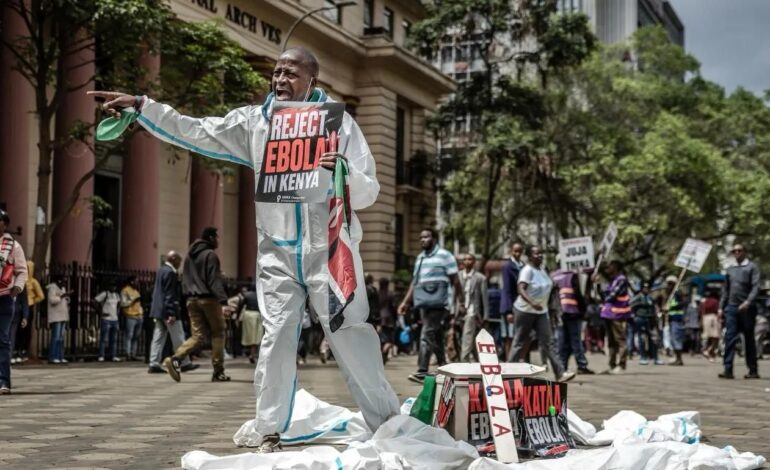
This sudden halt follows weeks of escalating civil unrest and deadly public demonstrations near the Laikipia site that left at least three citizens dead.

The 50-bed facility, intended to be managed by US medical personnel, was designed to quarantine American citizens exposed during the current outbreak in the Democratic Republic of Congo, where cases have crossed 1,048 with 267 deaths.

Under the arrangement, asymptomatic Americans would be held at the air base, while any individual testing positive would be evacuated to Europe. Local communities and medical unions vehemently rejected the project, accusing the state of compromising national sovereignty and risking the introduction of the lethal Bundibugyo strain into a country that has never recorded a single case of Ebola.
The legal battle was spearheaded by the Law Society of Kenya and the Katiba Institute, who petitioned the court on the grounds that the Ministry of Health secretly greenlit the high-containment site without mandatory public participation or environmental oversight. While the US government pledged 13.5 million USD in aid to bolster local bio-preparedness as part of the deal, opposition remained fierce against what many labeled an unacceptable arrangement to keep biological risks off American soil.

Despite the initial May court freeze, recent satellite imagery and flight-tracking data revealed that logistics planes continued landing at the air base to deliver construction containers, a move that pushed the judiciary to step in aggressively and enforce constitutional supremacy over foreign pacts.
Public healthcare advocates and infectious disease experts have voiced intense concern over the logistical design of the isolation network, arguing that it represents a risky departure from traditional containment protocols.
During previous outbreaks, exposed or infected Americans were routinely transported directly back to specialized biocontainment units within the United States for treatment and monitoring. By routing exposed personnel to East Africa instead, the current plan places an unfair structural burden on a regional health system that is already managing its own unique clinical demands, while raising serious bio-safety alarms regarding local community transmission.
The current crisis in the Democratic Republic of Congo continues to intensify, with confirmed cases jumping by 38% in a single week. This rapid spike has heightened the urgency of the situation, especially as neighboring Uganda has already documented 20 confirmed cases and two deaths linked to the same lethal strain. With the Laikipia project completely stalled, the broader strategy for managing exposed international personnel remains highly uncertain, forcing a major diplomatic reassessment of how cross-border biological threats should be contained without infringing on national sovereignty.
RELATED: