Wayne Lumbasi

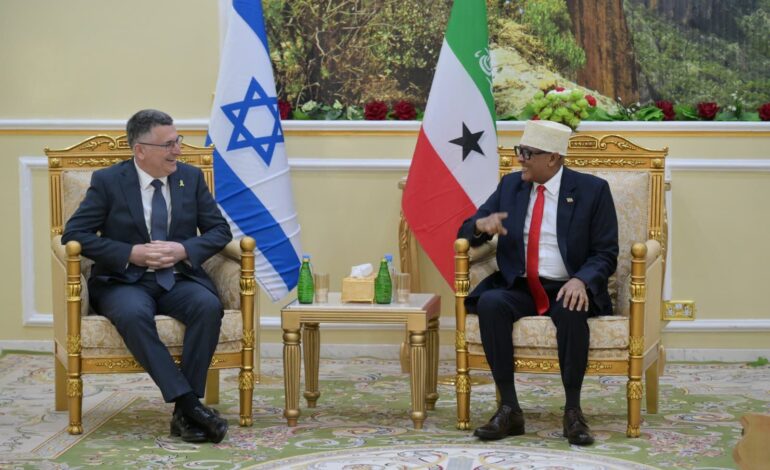
Somaliland is moving closer to a trade and investment agreement with Israel that could open access to key mineral resources, including lithium and other materials vital to global technology and energy supply chains. The effort follows Israel’s decision in December 2025 to formally recognise Somaliland’s independence, a move that broke with decades of international reluctance to acknowledge the self-declared state’s sovereignty .
President Abdirahman Mohamed Abdullahi said discussions are underway aimed at transforming diplomatic recognition into practical economic cooperation. Although no agreement has been finalised, he said expectations are high that commercial ties will begin taking shape through structured trade and investment arrangements .

Somaliland has promoted its largely untapped mineral potential as a central pillar of these discussions. Among the resources highlighted is lithium, a key component in electric vehicle batteries and renewable energy storage systems. In addition to minerals, Somaliland has pointed to oil and gas prospects, marine resources, agriculture, livestock, and fisheries as sectors capable of supporting long-term trade relationships. Abdullahisaid these resources offer a strong foundation for mutually beneficial exchange with Israel .

In return, Somaliland is seeking access to Israeli technology and investment across areas such as agriculture, water management, healthcare, energy, and innovation. The leadership in Hargeisa views economic partnerships as essential to accelerating development and strengthening institutions after more than three decades outside the global diplomatic system .
The outreach to Israel comes as Somaliland continues to expand its international economic footprint. The territory has already drawn significant foreign investment, particularly from the United Arab Emirates, which has backed the expansion of Berbera Port along the Gulf of Aden. The port sits near one of the world’s most heavily trafficked maritime routes and has become a cornerstone of Somaliland’s regional trade ambitions .
Israel’s recognition has sparked sharp reactions from Somalia, which maintains that Somaliland remains part of its territory. Concerns have also been raised by the African Union, China, Turkey, and Egypt, all of which have warned that recognition risks undermining Somalia’s territorial unity and complicating regional stability.
Despite the pushback, Somaliland’s leadership believes the recognition could encourage other countries to reconsider their stance. Abdullahi has expressed hope that states such as the United States and Saudi Arabia may eventually follow Israel’s example, though he acknowledged that such shifts are likely to be gradual and politically sensitive .
Questions have also emerged around security cooperation following the recognition. Somaliland has said that while future defence collaboration cannot be ruled out, there have been no discussions about hosting foreign military bases, stressing that economic development remains the primary focus of engagement with Israel .
If concluded, a trade pact anchored in mineral access and technology-driven investment would mark a major milestone in Somaliland’s long quest for international recognition, potentially reshaping economic and geopolitical dynamics in the Horn of Africa .
RELATED: