Faith Nyasuguta

Ghana and Burkina Faso have taken a major step toward strengthening cooperation by signing seven bilateral agreements designed to improve security, boost trade, and stabilize one of West Africa’s most important economic corridors. The agreements were finalized during a revived session of the Permanent Joint Commission for Cooperation, a diplomatic platform that had been inactive for six years.
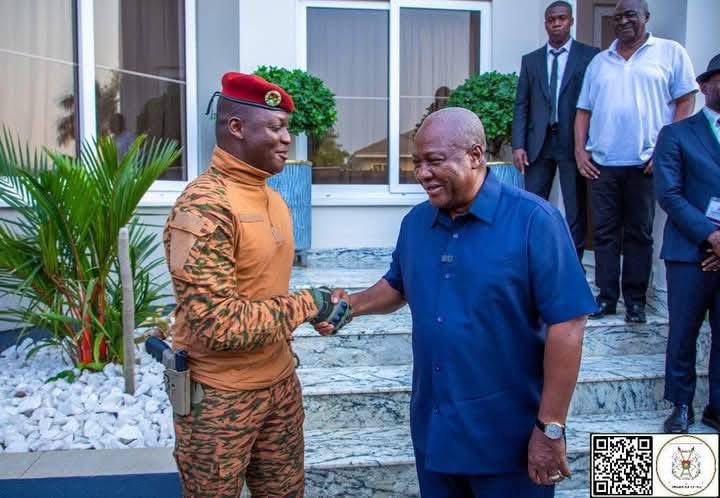
The renewed engagement reflects growing concern over insecurity across the Sahel and the need for neighboring countries to work more closely together. Officials say the move also signals a fresh phase in relations between Accra and Ouagadougou after years of limited engagement. Earlier political contacts between John Mahama and Ibrahim Traore helped reopen dialogue and laid the groundwork for the latest agreements.

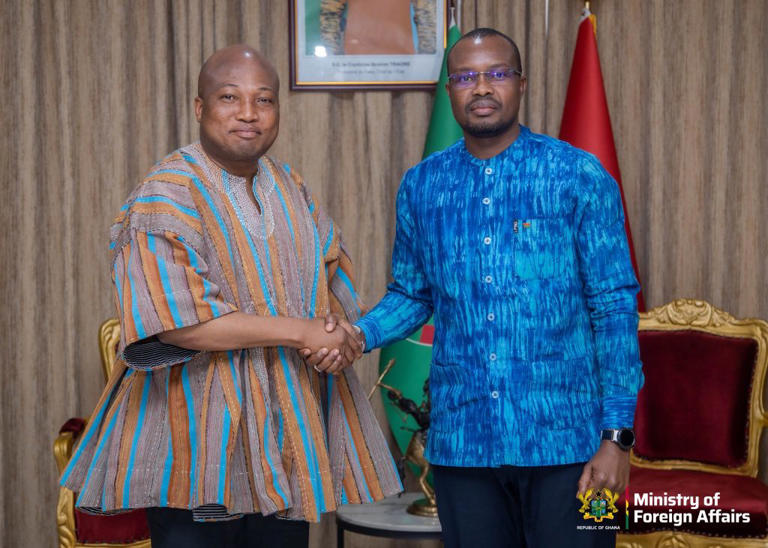
Security concerns were central to the discussions. Armed attacks and militant activity across the Sahel have increasingly affected border communities, traders, and transport networks. Ghana’s Foreign Minister Samuel Okudzeto Ablakwa recently visited victims of a February 14 attack in Titao who were receiving treatment at 37 Military Hospital. The attack reportedly killed several civilians, including Ghanaian traders, highlighting the cross-border nature of the threat.

/Ghana News Agency/
During the meeting, both governments strongly condemned terrorist attacks in the region and expressed solidarity with affected families. They agreed to develop a coordinated security framework aimed at tackling terrorism, violent extremism, and cross-border crime. The initiative is expected to strengthen intelligence sharing and operational coordination along their shared frontier.

Alongside security cooperation, both countries addressed humanitarian issues linked to the Bagre Dam. Periodic releases of water from the dam have historically caused flooding in northern Ghana, displacing communities and damaging farmland. Officials say new mechanisms will improve communication and disaster preparedness so that both governments can respond more effectively to future incidents.
Trade and transport were another major focus of the agreements. One of the most significant decisions is the mutual recognition of driver’s licenses between the two countries, a step expected to ease movement for transport operators and reduce bureaucratic delays. The measure is particularly important for traffic moving along the busy route linking Tema and Ouagadougou, a key commercial artery for goods traveling between the coast and inland markets.

Additional frameworks were adopted to harmonize transport rules, improve border governance, and establish regular consultations between local authorities operating along the frontier. These measures aim to reduce bottlenecks, strengthen oversight, and make trade more efficient for businesses operating across the region.
The agreements also include the creation of a joint commission tasked with reaffirming and clarifying the shared boundary between the two countries. Another deal focuses on disaster prevention and humanitarian crisis management, ensuring both governments can coordinate responses to emergencies affecting border communities.
In a further effort to strengthen regional security, the two nations signed an accord targeting the illicit cultivation, manufacture, and trafficking of narcotic drugs and psychotropic substances. Officials say the move is intended to protect young people while preventing criminal networks from exploiting cross-border routes.
Despite the broad scope of the agreements, Ghanaian officials stressed that their success will depend on implementation. Foreign Minister Ablakwa said the accords are not meant to remain symbolic documents but will instead be translated into concrete action.
Delegations from both countries described the talks as productive and forward-looking, reaffirming what they called long-standing cordial relations and shared ambitions for development and stability.
Analysts say the renewed cooperation comes at a critical time. The corridor linking Ghana’s ports to Burkina Faso is a lifeline for trade across parts of West Africa. For landlocked Burkina Faso in particular, access to coastal shipping routes is essential for economic activity.
However, the region has faced mounting pressure from militant violence, smuggling networks, and climate-related disruptions such as flooding. By strengthening security coordination, improving transport systems, and addressing humanitarian risks, the new agreements could play an important role in stabilizing one of West Africa’s most strategic trade routes.
For both countries, the reset in relations signals a pragmatic recognition that shared challenges require joint solutions. If the commitments made during the talks are effectively implemented, the partnership could improve economic flows, reinforce border stability, and support broader regional cooperation.
RELATED: